DJ Invoice Template and Event Planner Invoice Guide: Billing for Events and Entertainment
Build a DJ invoice template and event planner invoice handling deposits, equipment, overtime, travel, and vendor coordination fees.


The reception ends at 11 p.m. The bride asked for one more hour. The venue is fine with it, the photographer is packing up, and you still have lights running and a crowd that has not slowed down. You said yes an hour ago. Now the question is whether the overtime, the second speaker you brought because the room ran longer than expected, and the extra setup time at load-in are going to land on the final invoice cleanly — or get lost in a Sunday-morning text exchange with the planner.
A working dj invoice template — and the parallel event planner invoice that runs alongside it — needs to handle deposits, equipment, overtime, travel, and the occasional last-minute add. This guide walks through what a working invoice looks like for both DJs and event planners, including the deposit-to-balance flow that defines event billing and the multi-vendor coordination fees that decide whether a planner makes money on the event or not.
Why Event Billing Has Two Halves: Deposit and Balance
Event work runs on a deposit-and-balance model that is unlike almost any other invoicing rhythm. You quote in January, get paid a deposit in February, perform the event in October, and collect the balance the week of. The invoice has to track all three states without losing the thread.
The standard structure for both DJs and event planners:
- Booking deposit (or retainer) — 25–50% at contract signing. Holds the date. Most professionals use the word “retainer” instead of “deposit” because retainers are unambiguously non-refundable in most state laws while “deposit” can be read as refundable. The line on the invoice should read Booking retainer (non-refundable).
- Mid-payment — optional, 30–60 days before the event. Common on packages over $3,000. Surfaces payment problems before the event-day cash crunch.
- Final balance — due 7–14 days before the event. Standard policy is “balance due before the event,” not after. The line of credit you extend to clients ends when the music starts.
- Day-of add-ons — billed within 48 hours. Overtime, extra speakers, last-minute equipment requests. Itemized on a follow-up invoice that references the original.
The key move is making the payment schedule visible from day one. The first invoice you send should show package total, deposit applied, and balance due — even if the balance is not collectible for nine months. Couples and corporate clients budget around what they see, and surprises at the end of an event create exactly the relationship friction this industry runs on referrals to avoid.
What Should a DJ Invoice Template Include?
A dj invoice template, regardless of event type, needs the following core elements:
- Business info: company name, address, phone, email, logo, EIN if applicable
- Client info: name, billing address, event contact name and phone
- Event details: date, venue, load-in time, performance start and end, breakdown time
- Itemized line items: performance fee, equipment, travel, add-ons
- Deposit applied: shows what has already been paid
- Balance due: with a calendar date, not “upon receipt”
- Payment methods accepted: bank transfer, credit card, PayPal, Venmo
- Overtime rate: stated in advance, not invented after the fact
- Cancellation and refund policy reference: link to the contract or a one-line summary
- Late fee language: 1–2% per month on overdue balances
- Subtotal, tax (where applicable), and total
The level of detail in line items changes by event type. A four-hour wedding reception is structured differently from an eight-hour corporate gala or a private birthday in a restaurant back room. The sections below break each down.
DJ Performance Packages: What to Bundle vs. Itemize
The cleanest DJ invoice quotes a package as a single line and itemizes everything outside the package as separate lines. Typical SMB ranges from DJ industry surveys (American Disc Jockey Association data and DJ trade publications):
| Package type | Typical SMB range | Includes |
|---|---|---|
| Wedding DJ package (4 hours) | $800–$1,800 | DJ, basic sound, MC services, dance floor lighting |
| Wedding DJ package (6 hours) | $1,400–$2,800 | Adds ceremony sound, cocktail-hour music, uplighting |
| Corporate event DJ (4 hours) | $1,200–$3,500 | Higher-grade sound, professional MC, branded music programming |
| Birthday or private party (4 hours) | $500–$1,500 | DJ, sound, basic lighting |
| School dance / prom | $700–$1,600 | DJ, sound, dance floor lighting, age-appropriate library |
The package goes on one line. Anything outside the package goes on its own line: ceremony sound, additional hours, uplighting, monogram projection, photo booth, second speaker for outdoor coverage, extended dance-floor lighting. Itemized add-ons are where add-on revenue lives. A client looking at a package alone may not consider uplighting; a client looking at a clear $300 line for it often opts in.
Whether you charge a flat package rate or bill by the hour depends on your market and event type — see the flat rate vs. hourly rate breakdown for how other service pros structure this decision.
Equipment Rental and Sound and Lighting Add-Ons
Most professional DJs bring their own sound and lighting, but the gear-versus-talent split should still be visible on the invoice — particularly for corporate clients whose finance teams need to see what they are paying for. Itemize equipment when it is significant, when it is rented from a third party, or when the client has asked specifically about it.
Common equipment line items:
- Premium sound system upgrade — when the venue is large or outdoor. Flat upcharge.
- Wireless microphone — second handheld — for officiants, toasts, or panel events.
- Lavalier microphone (lapel mic) — for ceremonies or speeches at distance.
- Uplighting (per fixture or package) — typically $20–$40 per fixture, or $300–$600 for a venue-wide package.
- Monogram or gobo projection — flat fee, usually $150–$400.
- Cold-spark or dry-ice effects — venue-permitted only; flat fee plus operator time.
- Photo booth rental — separate package, often a separate invoice if you operate it as a sub-business.
- Generator rental — outdoor events with no power. Pass-through cost, often with a 10–15% coordination markup.
For pass-through equipment from a third-party rental house, two billing models work. Some DJs invoice at cost and let the client see the rental invoice; others mark up 10–20% to cover coordination. Either way, the line should make it clear: Generator rental (3,500W, 8 hours) — $385 is a clean line. Equipment — $385 is not.
How to Charge Overtime on a DJ Invoice
Overtime is the most reliable source of payment friction in DJ work. The fix is contractual: state the overtime rate on the booking contract and repeat it on the invoice itself, before the event happens.
Standard structures:
- Per-hour overtime rate — $150–$400 per hour, or any 30-minute increment. Most common.
- Per-30-minute overtime rate — $75–$200, for events likely to run a little long.
- Day-of cash overtime — some DJs accept overtime as cash on the night, with the receipt to follow. Others require a card on file before the event and bill the next morning. Either policy works; pick one and put it in writing.
The line on the post-event invoice reads: Overtime: 1.5 hours @ $200/hr (rate per signed contract) — $300. Reference back to the contract so there is no debate. DJs who skip this conversation at booking end up giving away an hour of work per event on average across a season.
Travel, Setup, and Breakdown Fees
Travel and setup are real costs on event work and clients expect them on the invoice when they exist. The conventions:
- Mileage — IRS standard rate, round-trip from your home base. Itemize: “Travel: 64 miles @ current IRS rate.”
- Day-of travel time — for venues more than 60–90 minutes each way, replace mileage with a flat half-day or full-day travel fee.
- Lodging — at cost when the event runs late and the drive home is impractical. Keep the receipt.
- Setup time beyond standard — most DJ packages include a 60–90 minute setup window. Setup time beyond that (early arrival for a venue load-in restriction, complex outdoor setups) bills at a stated hourly rate.
- Breakdown surcharge — late-night breakdowns past venue close-time bill at a premium.
Itemize travel with units and rates rather than a single “Travel — $150” line. Corporate clients with finance teams approve itemized travel without follow-up; lump-sum travel triggers questions and slows payment.
Event Planner Invoice Template: Coordination Fees and Vendor Markup
Event planner invoices have their own structure. Where DJs sell talent and equipment, planners sell coordination — the layer that holds caterers, florists, photographers, DJs, rentals, and the venue together. The event planner invoice template has to reflect both the planning fee and how vendor costs flow through.
Three vendor billing models, and the invoice line that makes each one transparent:
- Direct-billing model. Vendors bill the client directly. The planner’s invoice shows only the coordination fee. Cleanest model — the client sees what each vendor charges, and the planner is paid for time, not markup.
- Pass-through model. Vendors bill the planner; the planner re-bills the client at cost. The invoice itemizes each vendor as a pass-through line: Catering — Smith Catering (pass-through) — $4,200. Adds bookkeeping but keeps trust.
- Markup model. Vendors bill the planner; the planner re-bills the client at a marked-up rate (typically 10–20%). The markup either appears as a separate line (“Vendor coordination — 15%”) or is baked into each vendor line. Industry-standard practice is to disclose markup in the contract; hiding it is the fastest way to lose a client and a referral source.
For full-service event planning, the typical fee structures:
| Fee model | Typical SMB range | When it works |
|---|---|---|
| Flat planning fee (full-service wedding) | $3,500–$15,000 | Predictable scope, complete management |
| Percentage of event budget (10–20%) | varies with budget | Larger budgets ($50K+) where scope scales with spend |
| Hourly planning rate | $75–$250/hr | Partial planning, day-of coordination, consultations |
| Day-of coordination flat fee | $1,200–$3,500 | Couple plans, planner runs the event |
Whichever model you use, the contract and the first invoice should match. A planner who quotes hourly and invoices flat (or vice versa) creates a confusion that gets worse with every subsequent invoice.
Multi-Vendor Event Billing: How the Invoices Flow
For a wedding with a planner, DJ, photographer, caterer, florist, and venue, there is rarely one invoice — there are six to ten. The cleaner the flow, the fewer payment problems show up on the day. Two patterns work:
- Planner-run billing. Each vendor invoices the planner. The planner consolidates onto a master invoice with itemized vendor lines. Client pays one bill. Planner pays vendors. Works on full-service contracts where the planner has a markup or coordination fee built in.
- Direct-vendor billing with planner oversight. Each vendor invoices the client directly. The planner’s invoice covers coordination fees only. Client manages multiple payments. Works on partial-planning contracts where margins do not support pass-through risk.
The wrong move is mixing both — some vendors paid through the planner, some direct, with no clear paper trail. That is where revenue gets lost and where Sunday-morning text threads happen. The same multi-vendor coordination dynamic applies to adjacent creative roles — a photography invoice template for a wedding, for example, often runs alongside the planner’s master billing on the exact same deposit-then-balance schedule.
When to Send Each DJ or Event Invoice
Timing matters as much as format. Here is the standard send sequence for both DJs and event planners:
- Booking invoice — sent immediately after consultation, before calendar hold. Shows package total, deposit amount, and balance schedule. Client signs contract and pays deposit to confirm the date.
- Mid-event invoice (optional) — 30–60 days before the event for packages over $3,000. Brief note: “Second payment per schedule: [amount] due [date].”
- Final balance reminder — 14 days before the event. Pre-formats with the balance amount and due date already filled in.
- Day-of add-on invoice — within 48 hours of the event. Lists each add-on with the contract rate referenced. Do not wait a week; the memory of what was agreed fades fast.
Setting invoice payment terms explicitly on every invoice — with calendar dates rather than “upon receipt” or “net 30” — removes the follow-up conversation entirely for most clients.
How to Send Event Invoices From Anywhere
DJs and event planners do not invoice during the event. The booking invoice goes out from a coffee shop after the consultation. The mid-payment reminder fires from a hotel during a load-in for a different event. The final balance lands the week of, and the day-of overtime invoice goes out Sunday morning from a parked car.
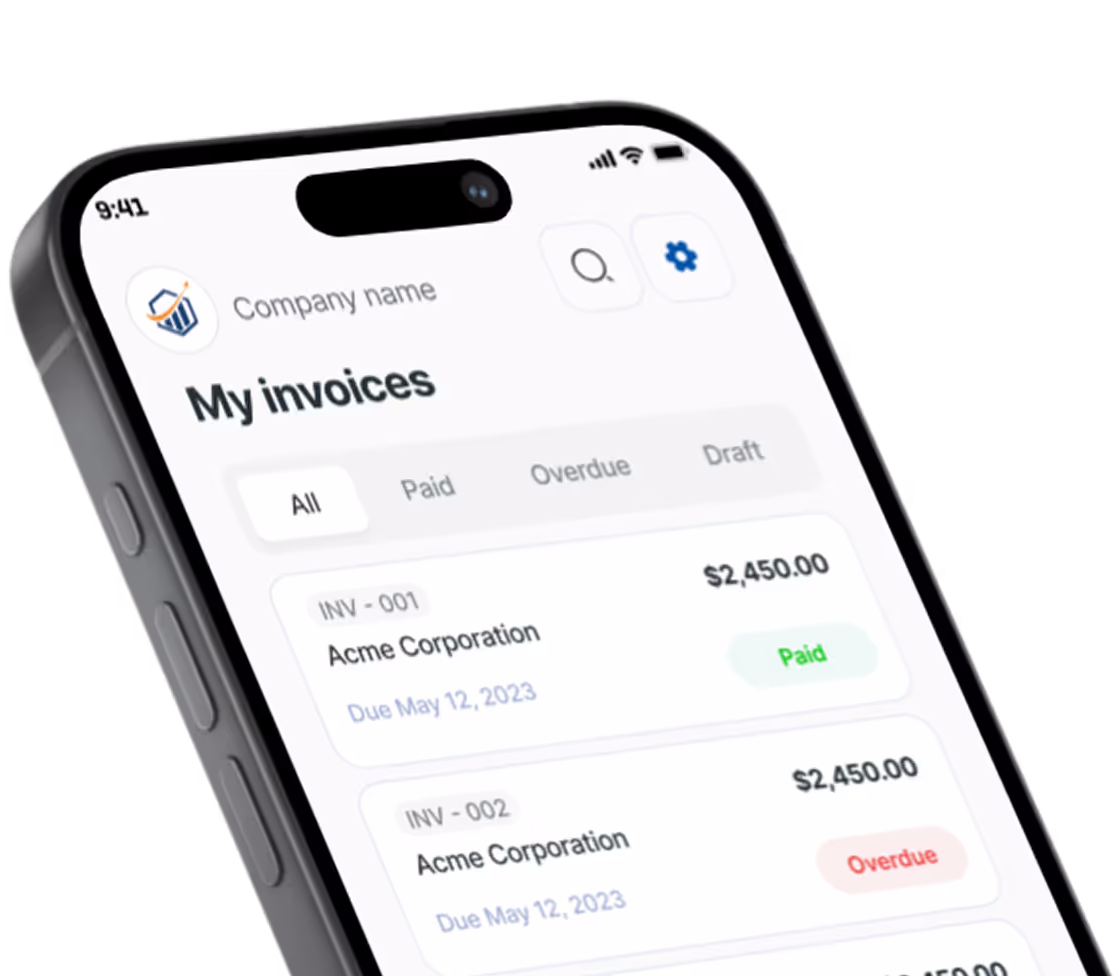
Pronto Invoice handles event billing from your phone. Describe the package in plain language (“wedding DJ 6 hours plus uplighting plus ceremony sound, $2,400 total, 50% retainer”) and the AI builds the invoice with line items, deposit applied, and balance reminders. Deposit invoices auto-apply to the event-day final billing — the booking retainer paid in February shows up as a deduction on the October balance invoice without a manual reconciliation step. No payment processing markup means whatever rate you negotiated with Stripe or PayPal is what you pay, which adds up fast when corporate gigs run $5,000–$15,000 and processing fees stack across a season. A free tier lets you start without a credit card.
Pronto Invoice sits alongside your event-management tools — it is not a replacement for HoneyBook, Dubsado, or Aisle Planner. Those handle inquiries, contracts, and timelines. The invoicing tool runs the money.
Frequently Asked Questions
What should a DJ invoice template include?
Business and contact info, client and event details (date, venue, performance window), itemized performance fee or package, equipment add-ons, overtime rate stated in advance, travel, deposit applied, balance due with a calendar date, accepted payment methods, late fee language, and a breakdown of subtotal, tax, and total.
How much deposit should I require for a DJ booking?
Industry standard is 25–50% non-refundable retainer at contract signing, with the balance due 7–14 days before the event. Use the word “retainer” rather than “deposit” on the invoice line so the non-refundable nature is unambiguous in most state laws.
Do event planners charge a vendor markup?
Some do, some do not. The three common models are direct billing (vendors bill the client, planner charges only a coordination fee), pass-through (planner re-bills vendors at cost), and markup (planner re-bills vendors at 10–20% over cost). Whichever model you use, the markup policy belongs in the contract and on the invoice.
How do I charge for overtime as a DJ?
State the overtime rate in the booking contract — typically $150–$400 per hour or in 30-minute increments — and repeat it on every invoice you send before the event. After the event, bill overtime as its own line referencing the contract rate. Skipping the conversation at booking is the most common cause of payment friction in DJ work.
Should I itemize equipment on a DJ invoice?
Itemize equipment when it is significant, when it is rented from a third party, or when the client is corporate and needs the breakdown for finance approval. Bundle equipment into the package when it is standard inventory you bring to every event. Either way, separate uplighting, monograms, photo booth, and pass-through rentals as their own lines — clients opt in more often when add-ons are visible.
How do event planners invoice for full-service weddings?
Most full-service planners use either a flat planning fee ($3,500–$15,000 for weddings), a percentage of the event budget (10–20%, typical on budgets over $50,000), or an hourly rate ($75–$250/hr) for partial planning. The first invoice shows the total fee, the deposit applied at contract signing, and the balance schedule. Vendor pass-through and markup, if any, follow the policy disclosed in the contract.
Key Takeaways
- Bill in two halves. Non-refundable retainer at booking, balance due before the event. Day-of add-ons go on a follow-up invoice within 48 hours.
- Quote packages, itemize add-ons. Wedding package on one line; uplighting, ceremony sound, monogram, photo booth, generators each on their own line.
- State the overtime rate before the event. Per-hour or per-30-minute rate, in the contract, repeated on every invoice. Reference the contract on the post-event overtime line.
- Itemize travel with units and rates. Mileage at the IRS rate, lodging at cost, setup time beyond standard at a stated hourly rate.
- Disclose vendor markup in writing. Direct billing, pass-through, or markup — pick one model and put it in the contract and on the invoice.
- Match the planner’s invoice to the contract. Hourly contract, hourly invoices. Flat-fee contract, flat-fee invoices. Mixing creates client confusion that compounds.
- Make the payment schedule visible from day one. First invoice shows package total, deposit, and balance — even when the balance is not collectible for months.
Your dj invoice template — and the event planner invoice that runs alongside it — is where the booking calendar meets cash flow. Quote the package, itemize the add-ons, document the overtime rate, and apply the deposit cleanly. The Sunday-morning text threads disappear.