Expanding Service Area for Small Business: A Field Guide
When to expand your service area, run break-even math, navigate licensing, and keep invoicing seamless across territories.


You finished a perfect install in your home territory yesterday. This morning, the third lead this week called from a town 45 minutes away — and you turned them down again because the drive eats your day. The work is there. The phone keeps ringing. But every time you say yes to a job 30 miles outside your usual radius, you lose two hours of billable time and a hundred dollars in fuel.
That tension — real demand on one side, real cost on the other — is what expanding your service area as a small business is actually about. It is not a marketing exercise. It is a math problem with a logistics layer on top, and most service businesses get the timing wrong in one of two directions: expanding too early because growth feels exciting, or waiting too long because the existing routes feel safe.
This guide walks through the readiness signals that tell you it is time, the financial model that tells you whether the new territory will actually be profitable, the licensing and insurance gotchas that catch first-time expanders, and the workflow changes that keep your team productive across a wider footprint.
Table of Contents
- When You Are Actually Ready to Expand
- The 5-Question Readiness Audit
- Researching the New Market Before You Commit
- The Expansion Math: Will This Territory Pay?
- Licensing, Insurance, and Tax Footprint Changes
- Marketing Into a New Zip Code
- Managing a Distributed Crew
- The 90-Day Expansion Checklist
When You Are Actually Ready to Expand Your Service Area
Geographic expansion is the right move when three conditions are simultaneously true:
- Your home territory is operating at or near capacity. You are turning down jobs, booked out two weeks or more, or losing leads because you cannot get there fast enough.
- You have at least one repeat-demand signal from outside your current radius. Existing clients moved and want to keep using you. Referrals are coming from neighboring towns. Inbound calls show a pattern, not a one-off.
- Your operations would survive you being unavailable for a week. If everything stops when you stop, expansion will break the business, not grow it.
If your home market still has white space, expansion is a distraction. The cheapest customer to acquire is the one in the zip code where you already have five-star reviews and word of mouth. Density beats reach almost every time for service businesses, because tighter routes mean lower fuel cost, more billable hours per day, and faster response times.
The most common expansion mistake is treating “we are getting calls from over there” as a green light. Calls are not commitments. Before you commit a single dollar of marketing or a single truck mile to a new area, run the readiness audit below.
The 5-Question Readiness Audit
Answer these honestly before you go any further. If you cannot answer yes to at least four, the timing is wrong.
1. Do you know your true cost-per-job in your current territory? You need to know your gross margin per service hour, fuel and vehicle cost per mile, and the average revenue per truck-roll. Without those numbers, you cannot model whether a new territory will be profitable. (Your cash flow forecast is the right place to keep these figures updated.)
2. Are your existing systems documented well enough that someone else could run them? Your invoicing, scheduling, payment collection, and client follow-up should not live entirely in your head. If a new tech in a new town needs you on the phone for every step, expansion will multiply your headaches, not your revenue.
3. Do you have at least 30 days of operating cash in reserve? New territories take 60 to 120 days to break even on customer acquisition. If a slow ramp would force you back into your home market early, you will sabotage the expansion before it has a chance.
4. Is your current team — even if it is just you and one helper — ready for the schedule strain? Expansion adds windshield time before it adds revenue. Make sure the human cost is something you have actually discussed with everyone affected. If expansion means you need more hands, review the decision framework for when to hire your first employee before you pull the trigger.
5. Have you talked to two or three potential customers in the new area? Before spending on marketing, call three referrals or contacts in the target zip code and ask: What do you currently use for this service? What do you wish was different? Would you switch to someone newer if pricing and quality were right? Live answers beat assumptions every time.
Researching the New Market Before You Commit
The new market is not just a geographic location — it is a competitive landscape, a price point, and a customer profile. You need to understand all three before you start spending.
Competitor density. Search Google Maps for your service category in the target town. Count how many established competitors show up in the top 20 results. Read the reviews — especially the one-star and two-star ones. Those are your wedge. If everyone in the area complains about no-shows and slow callbacks, your competitive advantage is operational reliability, and you can lead with that in your marketing.
Pricing benchmarks. Call two or three competitors as a prospective customer. Ask for ballpark pricing on a representative job. Most service businesses have price differences of 20 to 40 percent between markets even 30 miles apart. Going in blind on price is how new entrants lose money on every job for the first three months.
Demographics and demand signal. Use free tools — the Census Bureau’s American Community Survey for income and home age data, Google Trends for search interest in your service over the last two years in that metro, and your local Chamber of Commerce for new construction and business permit activity. Older homes mean more plumbing and HVAC work. Higher incomes mean less price-sensitivity. New construction means electrical, landscaping, and cleaning demand.
The drive-time test. Pull up Google Maps in the morning rush, again at midday, and again at 5 p.m. Time the drive from your current base to the center of the new territory in all three windows. If the worst-case drive turns a 4-hour job into a 7-hour shift, expansion will erode your margin even if the job itself is profitable on paper. Every mile you drive also has a deductible cost — make sure your mileage tracking is dialed in before you add a new territory’s routes to the mix.
The Expansion Math: Will This Territory Pay?
This is the section most “how to grow your service business” articles skip, and it is the only section that actually decides whether expansion works. You need a simple per-job profitability model for the new territory before you commit.
Here is the framework:
Step 1 — Calculate your fully-loaded cost per service hour. Take your total monthly costs (vehicle, fuel, insurance, software, phone, rent if any, your own salary or draw, helper wages, taxes set-aside) and divide by the number of billable hours you actually deliver in a month. Most one-truck operations land somewhere between $65 and $125 per fully-loaded hour. Multi-truck operations vary more.
Step 2 — Estimate the round-trip travel time premium. If your average current job is 4 hours of billable work plus 30 minutes of travel, and the new territory adds 90 minutes round-trip on top of that, you are now spending 6 hours to bill 4. Your effective hourly rate just dropped by a third.
Step 3 — Calculate the break-even price for the new territory. Multiply your fully-loaded hourly cost by total time on a representative job (including travel), then add a 25 to 35 percent margin. If that number is meaningfully higher than what local competitors charge, you have a problem. Either the territory is too far, you need to batch jobs to reduce travel-per-job, or this is not the right expansion target.
Step 4 — Model the path to density. A new territory only stays profitable long-term if you can build route density there. Set a 6-month milestone — for example, three jobs per visit-day, with zero days where a single job out there is the only reason for the trip. If you cannot see a path to that density, the territory is a one-off opportunity, not an expansion.
A worked example. A landscaping company at $85 fully-loaded hourly cost considers a new territory 35 minutes away. A typical job is 3 billable hours. With 70 minutes of additional round-trip drive, total time is 4 hours 10 minutes. Cost on the job is $354. With a 30 percent margin, the break-even price is $460. Local competitors charge $400 to $425. The math says no — unless the company can stack two jobs per trip, which drops effective travel-per-job to 35 minutes and brings the break-even to $383. Now the math works, but only at density.
Licensing, Insurance, and Tax Footprint Changes
This is the section that catches first-time expanders off guard. Crossing a city, county, or state line often triggers compliance costs that change the expansion math.
City and county business licenses. Many municipalities require a separate business license to operate within their jurisdiction, even for occasional jobs. Fees range from $25 to several hundred dollars annually. Check the target city’s website under “business licensing” or call the city clerk.
Trade-specific licensing. Plumbing, electrical, HVAC, contracting, and other licensed trades may require state-level licensing that does not transfer across state lines. If you currently hold a license in one state and are expanding to another, you may need to apply for reciprocity or take that state’s exam. Start this process at least 90 days before you plan to start working there — some states take that long to process applications.
Sales tax registration. If your state taxes services (most do not, but some do — check your state department of revenue), expanding to a new tax jurisdiction may mean registering for a separate sales tax account or filing in additional jurisdictions. Talk to your accountant before your first job in the new area.
Insurance coverage. Verify your general liability and commercial auto insurance covers work performed in the new territory. Some policies have geographic restrictions. If you cross state lines, you may need to add an additional state to your policy, which can shift your premium. Workers’ compensation rules also vary by state — if you have employees, this matters.
Vehicle registration and DOT. If your truck or van is now regularly operating in another state, you may need to update your commercial registration or obtain interstate authority. This applies more to longer-distance expansion than to neighboring towns.
Build the total annual compliance cost into your expansion math. A $300 city license, $800 in additional insurance premium, and $200 in accountant time is $1,300 you have to recover before the new territory contributes a dollar of profit.
Marketing Into a New Zip Code
You are not a known name in the new territory. Your reviews, referrals, and word of mouth are concentrated where you have been working — and they do not automatically travel 30 miles.
Local SEO comes first. Update your Google Business Profile to include the new service area. Add the new town’s name to the “service areas” field. Most service businesses can list up to 20 service areas. Create a dedicated landing page on your website for the new territory (“HVAC repair in [Town Name]”) with location-specific copy, not duplicated content from your main service page. This is the single highest-leverage marketing move and it costs nothing but a few hours.
Targeted local ads. Google Local Services Ads work well for service businesses because they only show to people actively searching in your service area. Start with a small daily budget ($25 to $50) and adjust based on lead quality, not just lead volume. Facebook geo-targeted ads work for some categories — landscaping, cleaning, and remodeling especially — less so for emergency-driven trades like HVAC repair where people search Google in the moment.
Direct outreach. For B2B-leaning services (commercial cleaning, light commercial HVAC, contractor referrals), 30 to 50 hand-addressed letters to property managers, building owners, and facility managers in the new area outperform digital ads in most cases. The response rate is small but the deals are bigger.
Tap your existing network for warm intros. Ask your three or four best customers in your home market if they know anyone in the new area. A single introduction from a happy customer is worth more than a month of cold ads, and it costs nothing.
Reviews are the gating factor. Until you have at least five Google reviews from customers in the new area, your local SEO will struggle. Make review requests a non-negotiable part of the workflow on every new-territory job for the first 90 days. If you want recurring revenue to stabilize the new territory faster, maintenance contracts are worth structuring from day one — they give you predictable jobs to anchor the route.
Managing a Distributed Crew Across Multiple Service Areas
Once you have a tech or two working out of your new territory, your operational complexity changes shape. Some practical patterns that work:
Standardize the job package. Whatever a tech needs to start a job — checklist, parts list, customer history, payment instructions — should travel with them digitally. If they have to call you to know what is in scope, you are the bottleneck and expansion will hit a ceiling fast.
Same-day invoicing, regardless of location. A tech finishing a job in the new territory should be able to send the invoice from the driveway, take payment, and move on — exactly the same workflow as in your home market. Mobile-first invoicing matters more as your geographic footprint grows, because you cannot physically drop by every job site at the end of the day to handle paperwork. This is the single biggest workflow change first-time expanders underestimate.
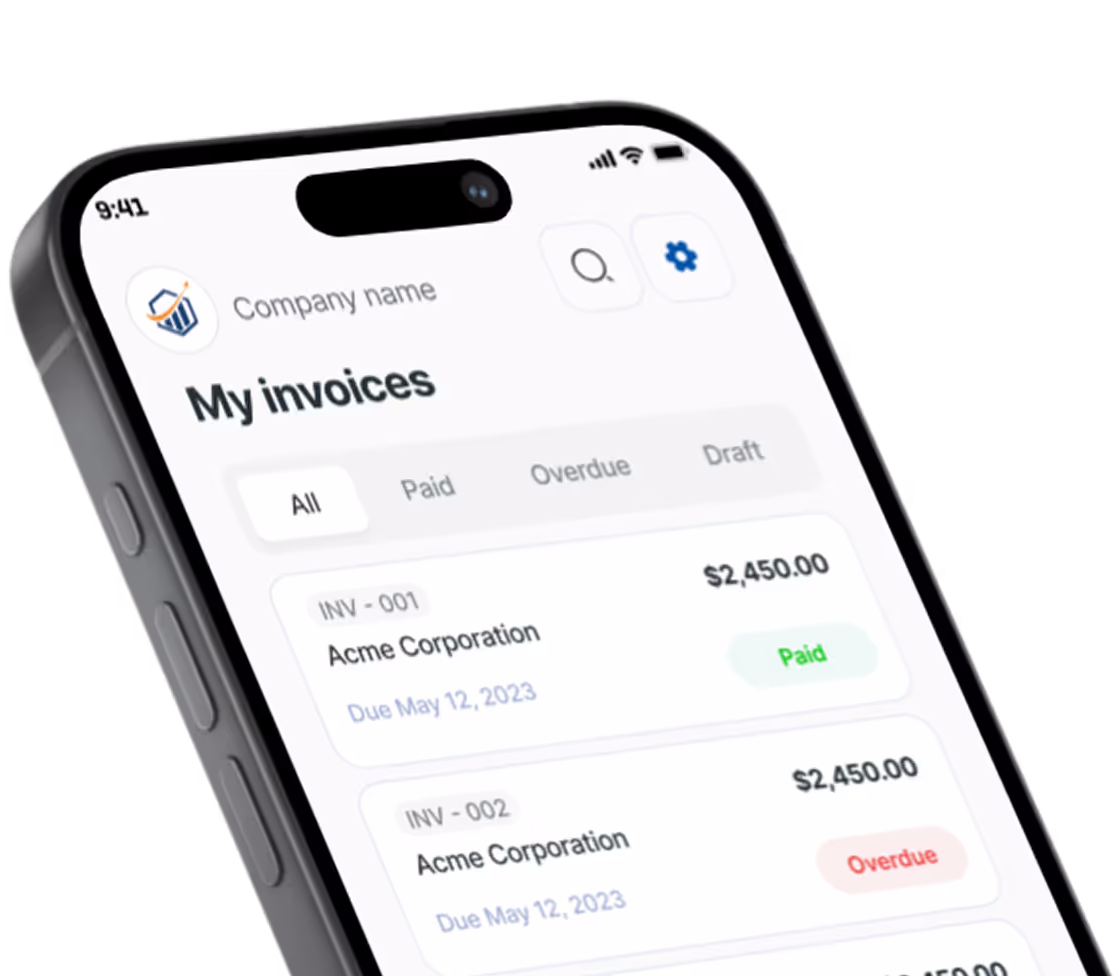
This is where Pronto Invoice fits naturally for service businesses growing into new areas. Pronto is mobile-first by design — your tech in a new zip code creates the invoice, accepts a card or ACH payment, and sends the receipt before pulling out of the driveway, exactly the same as in your home market. There is no separate setup for new territories, no different billing workflow, no “headquarters delays” — the new market gets the same professional invoicing experience your home market does, from day one. Start invoicing from every zip code you serve with Pronto Invoice.
Weekly route review. Once a week, look at where your trucks actually drove, where the jobs were, and where the gaps are. Most distributed teams discover within 60 days that one neighborhood inside the new territory is producing 60 percent of the jobs — that is your real expansion target, not the whole town.
Centralize what matters, decentralize what does not. Pricing, scope of work standards, customer communication tone, and quality benchmarks must stay centralized. Daily routing and on-the-ground decisions should belong to the tech in the territory. Trying to control both from headquarters slows everything down.
The 90-Day Expansion Checklist
Print this. Tape it to the wall. Cross items off as you go.
Days 1–14: Decide and de-risk
- Complete the 5-question readiness audit
- Run the expansion math for two representative jobs
- Identify the specific 5- to 10-mile radius inside the new territory you will actually target
- Talk to three potential customers in the area
- Confirm 30 days of cash reserves
Days 15–30: Compliance and infrastructure
- File for any required city, county, or state licenses
- Confirm insurance covers the new territory; update if needed
- Register for any new tax accounts your accountant flags
- Update your Google Business Profile service areas
- Build a dedicated landing page for the new territory on your website
Days 31–60: First jobs and feedback loop
- Take the first 5 to 10 jobs personally if you are owner-operator, even if you have crew. You need to feel the territory.
- Invoice from the field on every job — same-day, same workflow
- Ask every customer for a Google review
- Track every fuel and travel cost separately for the new territory
- Re-run the expansion math with real data after job #5
Days 61–90: Density push
- Aim for at least three repeat customers or referrals in the territory
- Identify the highest-density neighborhood and concentrate marketing there
- Reach 5+ Google reviews from the new area
- Hire or assign a primary tech for the territory if volume justifies it
- Decide: double down, hold steady, or pull back. Make this decision based on numbers, not feelings.
If at the 90-day mark you have not crossed break-even on the territory and you cannot see a clear path to density inside another 90 days, the expansion is not working. Pulling back is not failure — it is information. Most successful multi-territory service businesses have at least one expansion attempt that did not stick before the one that did.
The Bottom Line
Geographic expansion works when three things line up: your home market is full, the new market has real demand, and the math actually works at the price you can charge. It fails when the math is fuzzy, the licensing is an afterthought, or the workflow does not travel — when the same job done 30 miles away takes twice as long because the systems break down outside the home zip code.
The good news is none of this requires a corporate playbook. It requires honest numbers, a real conversation with potential customers in the new area, and a workflow — especially a billing workflow — that does not care where your truck is parked. Get those three right and expansion is just more of the work you already do well, in a new place.
When you are ready to grow, start invoicing on the road with Pronto Invoice — same workflow in every zip code you serve.
There is always something more to read

Equipment Financing for Small Business: Buy, Lease, or Finance?
Equipment financing for small business — cash, loans, leases, Section 179, and how to pick the right option.

Referral Program for Service Business: How to Build One That Works
Build a referral program for your service business with proven incentives, ask scripts, ROI math, and a 14-day launch plan.

When to Hire Your First Employee: A Financial Decision Framework
Revenue thresholds, true loaded cost, alternatives, and a 4-step decision model for owners ready to make their first hire.