How to Start a Consulting Business
Step-by-step guide to launching your consulting practice: niche, pricing, landing first clients, invoicing, and the part-time path to full-time.


You have ten or fifteen years of hard-won expertise. You know how to fix the thing your industry keeps getting wrong, and people at work already come to you for answers. But you are tired of trading your time for someone else’s salary, watching your advice make the company money while you take home a fixed paycheck.
Consulting sounds right. You set your own rates, pick your clients, and get paid for what you actually know. But it also sounds overwhelming: business structures, pricing, finding clients, legal paperwork, taxes. Where do you even start?
Here is the part nobody tells you. You do not need a year of preparation, a fancy office, or a finished website. If you set the foundation right, you can bill your first client inside 30 days. This guide on how to start a consulting business walks you through every step, with real numbers, real pricing math, and a tactical playbook for landing that first paying client.
The consulting market is large and growing. The global management consulting market hit $491.68 billion in 2025 and is projected to reach $520.47 billion in 2026 (Fortune Business Insights). There are roughly 1 million management consulting businesses in the US in 2026 (IBISWorld). There is room for one more, and it can be yours.
Table of Contents
- The Quick-Start Checklist
- Step 1: Define Your Consulting Niche
- Step 2: Start Part-Time (The Risk-Free Path)
- Step 3: Choose Your Business Structure
- Step 4: Handle the Legal Basics
- Step 5: Price Your Services
- Step 6: Build a Minimal Presence
- Step 7: Get Your First Clients
- Step 8: Set Up Your Finance Stack
- Frequently Asked Questions
The Quick-Start Checklist
Here is the whole path on one screen. Each item is a step in this guide.
- Define your niche and value proposition — what specific problem you solve, for whom
- Validate demand — talk to 5 potential clients before you build anything
- Choose a business structure — an LLC is the practical default
- Get an EIN and a business bank account — both free or fast
- Build a one-page website — a clear offer and a contact form, nothing more
- Set your pricing model and rate — hourly, project, or retainer
- Draft a simple contract or scope of work — protect yourself and the client
- Send your first invoice — the first real signal that you are in business
You can move through most of this in a weekend. The two parts that take real thought are your niche (Step 1) and your pricing (Step 5), so that is where this guide goes deepest.
Step 1: Define Your Consulting Niche
The fastest way to stall a new consulting business is to call yourself a “general consultant.” When you help everyone with everything, you are memorable to no one. A prospect cannot picture exactly what you do, so they do not think of you when the right problem shows up.
A niche fixes that. “I help dental practices cut no-show rates” is something a prospect can repeat to a friend. “I do operations consulting” is not.
How to find your niche
Your niche sits where three things overlap:
- Your experience — the work you have actually done, not the work you wish you had done
- Your results — the measurable wins you can point to (you cut costs 20%, you shipped the product, you turned the team around)
- Market need — a problem businesses already pay to solve
Write down the three or four things people at your current job ask you about most. That list is your raw material. The intersection of “what I am good at” and “what someone will write a check for” is your niche.
Niche vs. generalist
A narrow niche wins you clients faster and lets you charge more, because specialists command higher rates than generalists. The trade-off is a smaller pool of prospects. That is fine. You do not need thousands of clients. You need a handful of good ones who pay well.
You can always widen later. Start narrow, get known for one thing, then expand once you have momentum and testimonials.
Validate before you build
This is the step most people skip, and it is the cheapest insurance you will ever buy. Before you register a business or build a website, talk to 5 potential clients.
Reach out to five people in your target market — former colleagues, contacts who run businesses, people in the industry you served. Do not pitch. Ask:
- Is this problem real for you right now?
- How are you handling it today?
- If someone solved it, what would that be worth to you?
If four or five say “yes, this hurts, and I would pay to fix it,” you have a business. If they shrug, adjust your niche before you spend a dollar. This single conversation round saves people months of building the wrong thing.
Step 2: Start Part-Time (The Risk-Free Path)
Most guides on how to start a consulting business assume you quit your job on day one. That advice ignores how most successful consultants actually begin: on the side, while still drawing a paycheck.
Starting part-time is the smart move, especially if you are working out how to start a consulting business with no experience running one. You learn how to price, sell, and deliver while your bills are still covered. You de-risk the whole thing.
How much time it takes
Plan on a minimum of about 10 hours a week to get real traction — evenings and weekends to do outreach, take discovery calls, and deliver your first small projects. That is enough to land a client or two and prove the model without burning out.
When to go full-time
Do not quit on excitement. Quit on numbers. Two signals tell you it is time:
- Your monthly consulting income consistently matches or beats your salary, and
- You have saved roughly six months of expenses as a cushion
When both are true, the jump stops being a gamble and becomes a calculated move. Until then, keep the day job and let the side practice grow under it.
Check your employment contract first
Before you take a single client, read your employment agreement. Look for a moonlighting clause or a non-compete. Many contracts restrict outside work, especially work that competes with your employer or uses company resources.
The fix is usually simple: serve a different industry than your employer, do the work strictly on your own time and equipment, and when in doubt, ask HR or a lawyer. A quick check now beats a legal headache later.
Step 3: Choose Your Business Structure
You have two realistic options when you start: sole proprietorship or LLC. (For a deeper breakdown of every option, see our guide to business structure types.)
Sole proprietorship is the default if you do nothing. It is free and requires no filing, but it offers zero liability protection — your personal assets (house, savings, car) are exposed if a client ever sues over your advice.
An LLC is the practical default for most consultants. It creates a legal wall between your business and your personal assets, so a business problem stays a business problem. State filing costs run $50 to $300 depending on where you register, plus a small annual fee in some states. For the protection it buys, it is cheap.
What about an S-corp?
You will hear about S-corp election as a tax move. It can save you on self-employment taxes, but it only makes sense once your profit is substantial — generally well into six figures of net income — because it adds payroll, bookkeeping, and accountant costs. Ignore it on day one. Revisit it with an accountant once your revenue justifies the complexity.
Insurance you should consider
Two policies matter for consultants:
- Errors and omissions (E&O) insurance, also called professional liability — covers you if a client claims your advice caused them a loss
- General liability insurance — covers basic business risks
Together these typically run $500 to $1,500 a year for a solo consultant. Some clients, especially larger ones, will require proof of E&O before they sign. Budget for it.
Step 4: Handle the Legal Basics
The legal setup for a consulting business is lighter than you expect, and most of it is free or near-free. Do not over-engineer this before your first client.
Get an EIN (free, 10 minutes)
An EIN (Employer Identification Number) is your business’s tax ID. Applying is free and takes about 10 minutes on the official IRS website (IRS.gov). Beware of sites that charge for this — the IRS does it at no cost. You will need the EIN to open a business bank account.
Open a business bank account
Most banks approve a business checking account the same day, often online. Keep your business money completely separate from your personal money from day one. It makes taxes painless and keeps your LLC’s liability protection intact. (Mixing funds can undo the legal wall you set up in Step 3.)
Draft a simple contract or scope of work
You do not need a lawyer to write your first agreement, but you do need something in writing. A basic consulting contract or scope of work (SOW) should spell out:
- What you will deliver — the specific work and outcomes
- What is out of scope — just as important, to prevent scope creep
- Timeline — start, milestones, and end
- Price and payment terms — amount, schedule, and when payment is due
- How either side can end the agreement
A clear one-page SOW prevents most disputes. Keep it simple for now and refine it as you grow.
Step 5: Price Your Services
Pricing is where new consultants leave the most money on the table, so this is the section to read twice. Get it right and the rest of the business gets easier. Charge too little and you trap yourself in a rate that is hard to climb out of.
The three pricing models
There are three main ways to price consulting work. You will likely use all three over time.
Hourly. You charge for the time you spend. It is the simplest model and the easiest to explain, which makes it a fine starting point for early clients. The downside: your income is capped by your hours, and you are vulnerable to scope pressure — clients watch the clock and question every hour.
Project-based. You quote one fixed price for a defined outcome (“I will redesign your onboarding process for $8,000”). This usually earns a higher effective hourly rate because you are paid for the result, not the hours. It also protects your time — if you work faster, you keep the upside. The catch: you need a crystal-clear scope, or you will eat the overage.
Retainer. The client pays a set amount every month for ongoing access to your expertise. This is the most stable model and the holy grail for a consulting business, because it turns unpredictable project income into predictable monthly revenue. It works best for ongoing advisory relationships where the client needs you on call.
On the consulting retainer vs hourly question: start hourly or project-based to land clients and prove value, then move your best ongoing relationships onto a retainer once they trust you. Retainers are where stable income lives.
The hourly rate formula
Here is how to price consulting services without guessing. Work backward from the income you want, in plain steps:
- Start with your target annual income. Say you want $100,000.
- Add overhead. As a self-employed consultant, you cover taxes, insurance, software, and your own benefits — budget roughly 30% on top. That takes $100,000 to about $130,000.
- Divide by your realistic billable hours. You cannot bill 40 hours a week — much of your time goes to sales, admin, and downtime. A part-timer starting out should plan on about 1,000 billable hours a year. A full-time consultant lands around 1,500 to 1,800.
So: $130,000 ÷ 1,000 hours = $130 per hour as your minimum. If you plan to work full-time at 1,500 hours, the same income target supports a lower hourly rate — but most consultants aim higher than the minimum, not lower.
That number is a floor, not a ceiling. It is what you must charge to hit your income goal. Charge below it and you are working at a loss.
Industry rate benchmarks
For context, here are typical hourly ranges by specialty. (Treat these as rough ranges, not exact survey data — published consulting rates vary widely and shift over time.)
| Specialty | Typical hourly range |
|---|---|
| Business / management consulting | $150–$350/hr |
| IT / technology consulting | $100–$300/hr |
| Marketing consulting | $75–$250/hr |
| HR consulting | $75–$200/hr |
Where you land in the range depends on your experience, your results, and how clearly you solve an expensive problem. Technology consulting in particular is forecast to surpass $400 billion in 2026 (Source Global Research), and digital transformation work makes up 24.73% of the US consulting market, growing at a 6.11% CAGR (Mordor Intelligence) — so demand for technical specialists is strong.
The most common pricing mistake
The number one mistake is undercharging your first client to “get the foot in the door.” It feels safe. It is a trap. That first rate becomes your reference point — it frames what future clients expect, and raising it later is awkward. Set a rate you can stand behind from client one.
When you do raise rates down the road, it is straightforward to adjust. A clean, professional invoice that itemizes your time and deliverables shows clients exactly what they are paying for, which makes a rate that reflects your value feel fair rather than surprising.
Step 6: Build a Minimal Presence
You need just enough online presence for a prospect to believe you are real. You do not need a ten-page website, a logo competition, or a brand video. Overbuilding here is a classic delay trap — people polish a website for two months instead of talking to clients.
A one-page website
One page is plenty to start. It needs:
- A clear headline stating who you help and what problem you solve
- A short section on your approach and results
- A contact form or a way to book a call
That is it. You can build it on a simple site builder in an afternoon.
Get LinkedIn in sync
LinkedIn is where most B2B prospects will check you out, so make it match your offer:
- Add “Consultant” (or your specific niche) to your headline
- Rewrite your summary to speak to the problem you solve, not your job history
- Post one piece of expertise a week — a tip, a lesson, an answer to a question clients ask
An email signature with your offer
Add a one-line offer to your email signature (“Helping [audience] [solve problem] — book a call”). Every email you already send becomes quiet marketing. None of this should take more than a day. Resist the urge to overbuild before you have landed a paying client.
Step 7: Get Your First Clients
This is the part that decides whether you have a business or a hobby. Here is the tactical playbook for how to get consulting clients — in the order that actually works.
1. Start with your warm network
Your first clients almost always come from people who already know your work: former managers, colleagues, and clients. They have seen what you can do, so the trust is already there.
Write a short, no-pressure “what I’m doing now” message. Do not pitch. Just update them: “I’ve started consulting on [your niche]. If you ever run into [problem], I’d love to help.” Then ask each contact for one introduction to someone who might benefit. Warm intros convert far better than cold outreach. (For more plays, see our guide on getting your first clients.)
2. Do targeted LinkedIn outreach
Make a list of 10 ideal clients — specific people at specific companies who fit your niche. Send each a personal connection note that references a shared context (a mutual contact, their recent post, a challenge their industry faces). No pitch in the first message. You are starting a conversation, not closing a sale.
3. Offer one free discovery call
When someone shows interest, offer a 30-minute discovery call. The only goal is to understand their problem deeply. Do not pitch your retainer on this call. Ask questions, listen, and let them describe the pain in their own words. People buy from consultants who clearly understand their problem — and you cannot understand it without listening first.
4. Land a first paid project
Aim for a first project that is smaller than you would like — a focused, well-scoped piece of work you can close quickly and deliver well. The goal is not the fee. It is the testimonial and the referral you earn by doing great work. One happy client becomes your next two clients.
5. Use content as a slow burn
Short LinkedIn posts on your specialty — questions answered, problems solved, lessons shared — build a steady inbound stream over time. It is slower than direct outreach, so do not wait on it, but it compounds. A few months of consistent posting and prospects start coming to you.
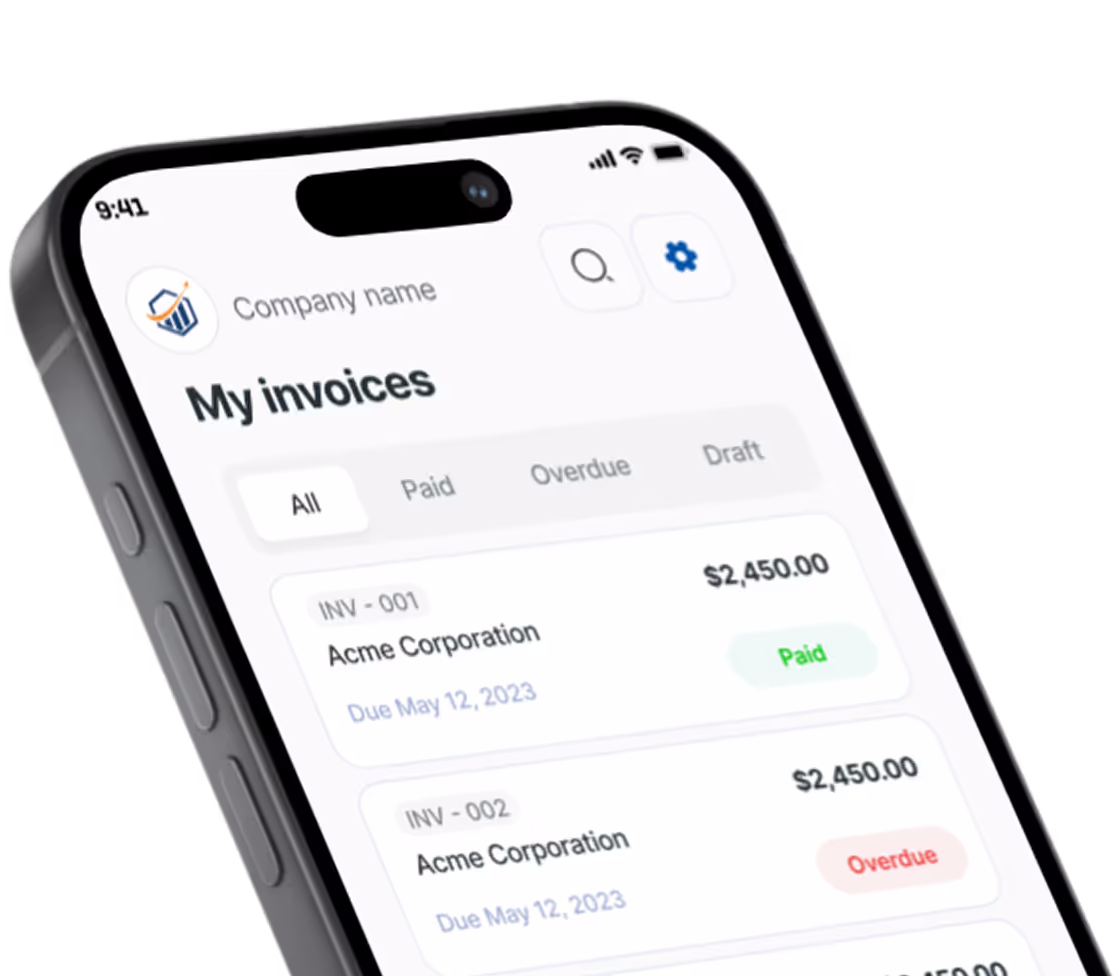
Throughout all of this, your professionalism shows in the small things. When you send a proposal or your first invoice straight from your phone — clean, itemized, and prompt — it tells a new client your business is buttoned up. That first invoice is often a client’s first real impression of how you run things.
Step 8: Set Up Your Finance Stack
Your finance setup does not need to be complicated, but it does need to exist before the money starts moving. Here is the lean stack.
Business bank account
You set this up in Step 4. Keep using it for everything business-related. Every client payment in, every business expense out.
Invoicing
Send your invoices the moment work is done or due. Late invoicing signals disorganization, and it is the fastest way to teach a client that paying you slowly is fine. Match your invoice type to your pricing model:
- Retainer invoices go out on the 1st of each month, like clockwork
- Project milestone invoices are tied to deliverable approval — bill when a phase is signed off
- Use Net 15 or Net 30 payment terms. For new clients, shorter is better — Net 15 gets you paid faster and tests whether they pay on time
If you bill for ongoing advisory work, recurring retainer invoices that send themselves on a schedule save you from re-creating the same invoice every month. For the mechanics of itemizing consulting time and structuring the document, see how to write a consulting invoice.
Set aside money for taxes
No employer is withholding taxes for you anymore — that is now your job. Set aside roughly 25% to 30% of every payment the moment it lands, in a separate account, for self-employment and income taxes. Consultants who skip this get a brutal surprise in April. To understand exactly what you owe and why, read self-employment taxes explained.
Track expenses simply
You do not need accounting software on day one. Keep one folder on your phone for receipts, snap a photo of each one, and review the folder monthly. Every legitimate business expense — software, insurance, your home office, travel — lowers your taxable income.
This is where the right invoicing tool earns its keep. Pronto Invoice lets you set up retainer invoices that go out automatically each month and milestone invoices tied to your project phases — so your billing keeps pace with your work without you re-doing admin every cycle. You send a clean, professional invoice from your phone in under a minute, and you get paid faster because of it.
Frequently Asked Questions
How much does it cost to start a consulting business?
A lean consulting business costs surprisingly little to launch. The main expenses are LLC filing ($50–$300) and insurance ($500–$1,500 a year). Add a simple website and a few software tools, and most consultants get started on a total budget of $1,000 to $5,000 — and you can start at the lower end if you keep it minimal.
Do I need a license or certification to consult?
In most fields, no. You can hang a shingle as a marketing, operations, or management consultant without any license. The exceptions are regulated fields — financial advisory, legal advice, engineering, accounting, and similar — which do require specific licenses or certifications. If your field is regulated, confirm the requirements before you take clients.
How much should I charge?
Use the formula in Step 5: take your target income, add about 30% for overhead, and divide by your realistic billable hours. That gives your minimum rate. Industry ranges run roughly $75 to $350+ per hour depending on your specialty, with business and management consulting at the top and HR or early-stage marketing at the more accessible end.
How do I find my first consulting client?
Go to your warm network first — former managers, colleagues, and clients who know your work. Then do targeted LinkedIn outreach to ideal prospects. Specialized platforms like Toptal or Catalant can be a third source, especially in tech. Most first clients come from a warm introduction, so start there.
Can I start consulting part-time?
Yes — and for most people it is the recommended path. Starting while you keep your day job lets you learn pricing, sales, and delivery with your income still covered. Plan on about 10 hours a week, and go full-time only when your consulting income matches your salary and you have a six-month cushion saved.
How long until I’m profitable?
Because consulting has such low overhead, profitability comes fast. Solo consultants with lean costs often reach profitability within 2 to 6 months of landing their first client. Your biggest expenses are your time and a few hundred dollars of setup — so once clients are paying, you are usually in the black quickly.
Should I use a consulting platform like Toptal or Catalant?
These platforms can be useful, especially for technology and specialized fields, because they give you an instant pipeline of clients without doing your own outreach. The trade-off is lower rates, since the platform takes a cut and clients compare on price. Treat them as a supplement to your own client acquisition, not a replacement for building your own network.
What if I have no experience running a business?
That is the normal starting point. You do not need business experience to start a consulting business — you need expertise in your field and a willingness to learn the rest. The part-time path in Step 2 exists exactly for this: it lets you learn how to price, sell, and bill while the stakes are low and your paycheck still covers your bills.
Starting a consulting business is less about paperwork and more about momentum. Define your niche, validate it with five real conversations, set up the legal basics in a weekend, price your work with confidence, and start the outreach that lands your first client. Do that, and billing your first client inside 30 days is realistic, not optimistic.
When you reach that first invoice, make it count. Pronto Invoice lets you send professional, itemized invoices from your phone, set up retainers that go out on their own each month, and tie milestone billing to your project phases — so your billing keeps pace with your work and you get paid faster. Your first invoice is your first impression. Make it a professional one.
There is always something more to read

10 Steps to Set Up a Small Business: The Complete Startup Checklist for 2025
Learn 10 steps to set up a small business with this checklist covering LLC, banking, invoicing, insurance, and pricing.

1099 Requirements for Small Business (2026): Complete Guide
$600 threshold is now $2,000 for 2026. Learn 1099 requirements: 1099-NEC, W-9 rules, deadlines, filing.

How to Accept Payments Online
No website needed. Here is how to start accepting online payments as a small business — processors, payment links, and invoicing in one afternoon.