Recurring Revenue for Service Businesses: Maintenance Contracts Guide
Build recurring revenue with maintenance contracts. Pricing, contract terms, auto-renewal, and the math that makes it work.


It is the third Tuesday of February. Outside, the temperature dropped below freezing two nights ago. Your phone has been ringing since 6 a.m. — frozen pipes, no-heat calls, two emergency furnace replacements before lunch. The cash is great. The phone calls stop in April.
By June, you are reading the bank balance every morning and wondering if you should let the second tech go for the slow season.
This is the rhythm of a one-time-job service business. You eat what you kill, and the killing is seasonal. The fix is not more leads. It is a different revenue structure.
Recurring revenue for service business owners is not a startup buzzword. It is the same maintenance contract your grandfather sold on oil burners — modernized, priced honestly, and signed up front so you know in January what April will pay. This guide covers the contract structures that work for service trades, the pricing math that makes them profitable, the contract terms you need before a customer signs, and how to renew them without losing 30% every December.
Table of Contents
- What Counts as Recurring Revenue in a Service Business
- The Math: Why $99/Month Beats a $1,200 Job
- Maintenance Contract Structures by Trade
- How to Price a Maintenance Contract
- Contract Terms That Protect You
- Auto-Renewal: The Single Biggest Lever
- How to Sell the First 10 Contracts
- Billing the Contract Without Losing Hours to Admin
- Common Mistakes That Kill Contract Programs
What Counts as Recurring Revenue in a Service Business
Recurring revenue is income you can count on before you do the work. The customer has agreed — in writing — to pay you on a schedule, whether you have spoken to them this month or not.
In a service business, recurring revenue typically takes one of four forms:
- Maintenance contracts. A flat monthly or annual fee in exchange for scheduled visits (HVAC tune-ups, lawn care, pool service, IT monitoring).
- Service plans with priority access. The customer pays a monthly fee for a discount on parts and labor, plus front-of-line emergency service. No scheduled visits required.
- Retainers. Common in IT, marketing, and consulting — a monthly fee for a set number of hours or a defined scope.
- Subscriptions. Equipment-as-a-service or supplies-replenishment models. Less common in trades, growing in cleaning and pest control.
The shared mechanic is the same: the customer commits to a payment schedule before any individual job is performed. You invoice on that schedule. The cash arrives on that schedule.
Recurring revenue is not the same as repeat business. A customer who calls you every spring for a tune-up is repeat business. A customer with a signed maintenance agreement and a monthly invoice is recurring revenue. The difference is whether the cash shows up if you do nothing.
The Math: Why $99/Month Beats a $1,200 Job
Most service business owners undervalue contracts because they compare the wrong numbers.
Consider a residential HVAC contractor weighing two scenarios:
| One-time job | Maintenance contract | |
|---|---|---|
| Visible revenue per customer | $1,200 emergency repair | $99/month → $1,188/year |
| Frequency | Once every 2-3 years | Monthly, 12 months/year |
| Customer acquisition cost | $200-400 (Google Ads, lead service) | Same $200-400, but recurring |
| Year 1 revenue | $1,200 | $1,188 |
| Year 3 revenue | ~$1,200 | $3,564 |
| Year 5 revenue | ~$2,400 | $5,940 |
| Cash flow predictability | Low — depends on calls | High — known monthly |
| Resale value of customer base | Modest | 1.5-3x annual recurring revenue |
The one-time job looks bigger on paper. Over three years, the contract earns three times as much per customer, with a fraction of the marketing spend, on a schedule you can plan against.
There is a second number that matters more than revenue: business valuation. When a service business sells, buyers pay a multiple of recurring revenue, not a multiple of one-time jobs. A book of 200 maintenance contracts at $99/month — about $237,600 in annual recurring revenue — typically sells for $350,000 to $700,000. A list of 200 customers who sometimes call when something breaks sells for the value of the trucks.
Recurring revenue is what turns a service trade from a job into an asset.
Maintenance Contract Structures by Trade
Every trade has its own version of the contract, shaped by what actually needs maintaining and how often. The structures below come from how working contractors price these in real markets.
HVAC
The classic two-visit-per-year plan: spring AC tune-up, fall heating tune-up. Common pricing: $180-$300 per year, paid annually or monthly. Premium tiers add priority emergency service, 10-15% parts discount, and waived diagnostic fees. The math works because each visit takes 45-60 minutes and you bundle four to six visits into a single service-route day. HVAC contractors who have built recurring maintenance programs report customer retention rates as high as 96% — compared to 30-50% annual churn on transactional repair customers.
Landscaping and Lawn Care
Weekly or bi-weekly cuts during the growing season, plus seasonal services (spring cleanup, fall leaf removal, mulch). Most regions charge a monthly flat fee that averages the seasonal load — $150-$400/month for residential — so the customer pays the same in February (no work) as in July (every week). The flat-fee model is what makes lawn care a recurring revenue business instead of a seasonal one.
Cleaning Services
Recurring weekly, bi-weekly, or monthly cleans on the same day each cycle. Residential pricing $120-$300 per visit; commercial $200-$2,000+ per visit depending on square footage. Auto-billed against the visit schedule.
IT Managed Services
Monthly fee per endpoint or per user, covering monitoring, patching, helpdesk, backups. Common pricing: $75-$150 per user per month, or $50-$100 per endpoint per month. Higher tiers add cybersecurity stack and after-hours response. This is the highest-margin recurring revenue model in the service trades when sold to small business clients.
Plumbing
Less mature as a contract category, but growing. Annual whole-home plumbing inspection plus a small water-heater flush, typically $150-$250/year. Premium plans add priority service and parts discounts. Often sold as an add-on after a repair call, not as a stand-alone offer.
Pool Service
Weekly chemical-and-clean visits, $150-$300/month residential. Equipment-repair labor billed separately or bundled at premium tier. Strongly seasonal in northern markets, year-round in the South.
Pest Control
Quarterly perimeter treatment plus call-back guarantee. $120-$200 per quarter or $40-$70/month auto-billed. The call-back guarantee is the value: if pests return between visits, you come back at no charge.
The pattern across all of these: a defined work scope, a defined visit cadence, a flat fee, and (critically) an auto-billing schedule that does not require the customer to do anything to keep paying.
How to Price a Maintenance Contract for Your Service Business
Most service businesses price contracts by guessing what feels reasonable. The result is contracts that lose money when scope creep hits, or contracts so expensive nobody buys them.
The honest pricing formula:
Contract price = (Direct labor cost × visits per year) + (Materials & consumables) + (Overhead allocation) + (Target margin)
Walk through it for a two-visit-per-year HVAC plan:
- Direct labor: 1 hour per visit × 2 visits × $65/hour fully loaded labor cost = $130
- Materials and consumables (filters, tape, caps): $25
- Truck, fuel, scheduling overhead: $40
- Subtotal cost: $195
- Target gross margin 50%: $390 retail
If your market only supports $250 plans, you have three options:
- Reduce scope (one visit instead of two)
- Reduce overhead (route density — three contracts on the same street is dramatically cheaper than three across town)
- Move premium features to a higher tier and price the basic plan to win the door
The biggest leverage in contract margin is route density. A maintenance route that hits eight contracts in one neighborhood in a single day is profitable at any reasonable price. The same eight contracts spread across an entire metro is a losing business.
When you set monthly pricing, do not just divide annual price by 12. Add 5-10% for the cost of monthly billing and the time-value of getting the cash later. A $300 annual plan should be $26-$28/month, not $25.
One more note on scope: the scope creep prevention discipline that protects per-job profitability applies equally to contracts. If your maintenance contract visit runs 90 minutes instead of the budgeted 60 because the customer always has “one more thing,” that extra 30 minutes destroys your margin on every renewal.
Contract Terms That Protect You
A maintenance contract that is just a price and a visit schedule is incomplete. The terms are what keep the contract profitable when the easy customer turns into the difficult one.
Every maintenance contract should specify:
- Scope. What is included? What specifically is not? “Filter replacement (standard 1-inch pleated)” — not “filter service.” Be precise enough that a court could read it.
- Visit frequency and scheduling rules. “Two visits per calendar year, scheduled by the company. Customer will receive 7 days’ notice; rescheduling allowed once per visit at no charge.”
- Response time for non-emergency requests. “Response within 2 business days for non-emergency calls.”
- Emergency response definition. What counts as an emergency? After-hours rate? Or covered?
- Parts and labor terms for non-covered work. Discount percentage, parts cost basis (your cost vs. retail), labor rate.
- Term length and renewal. “Initial term: 12 months. Renews automatically for additional 12-month terms unless cancelled in writing 30 days before renewal.”
- Cancellation policy. Mid-term cancellation fee (or no mid-term cancellation). Pro-rated refunds (or no refunds).
- Price escalation. “Annual renewal price may increase by up to CPI or 5%, whichever is greater.” Without this clause, your costs rise and your contract revenue does not.
- Property access requirements. What happens if the customer is not home? Do you reschedule? Charge a trip fee? Both?
- Service area limit. If the customer moves outside your area, the contract terminates.
A boilerplate maintenance agreement template that covers all of these runs three to four pages. Have a local attorney review the first one. After that, you reuse the same agreement with minor scope adjustments per trade vertical.
Setting clear expectations in the contract is also the foundation of a solid client onboarding process — the first 30 days after a customer signs sets the tone for whether they renew.
Auto-Renewal: The Single Biggest Lever
A 12-month contract with manual renewal loses 25-40% of customers each renewal cycle. Not because they are unhappy — because nobody got around to signing the renewal.
A 12-month contract with auto-renewal and a 30-day cancellation window loses 5-12% of customers each renewal cycle. Research from FieldEdge across HVAC maintenance programs shows 80-90% renewal rates for auto-renewing maintenance agreement customers. Same product. Same satisfaction. Different default.
The mechanic is simple. Manual renewal makes the customer take action to keep paying you. Most won’t, even when they meant to. Auto-renewal makes the customer take action to stop paying you. Most won’t, because the service is fine and the bill is small relative to the hassle.
Three things have to be true to use auto-renewal ethically:
- The contract clearly states it. Auto-renewal is not buried in paragraph 14. It is bolded near the signature line.
- You notify before each renewal. A 30-60-day pre-renewal email or text reminding the customer of the renewal date and giving them an easy cancellation path.
- Cancellation is genuinely easy. Reply to the email. One phone call. No retention-team gauntlet.
Some states require explicit auto-renewal disclosure language. California, New York, Illinois, and several others have specific automatic-renewal statutes — the contract has to disclose the renewal terms, the cancellation method, and provide cancellation reminders. Check your state.
Auto-renewal done honestly is the difference between a contract program that compounds and one that bleeds.
How to Sell the First 10 Contracts
Most service business owners try to sell contracts to cold leads through marketing campaigns. That is the hardest possible path. The easy path is selling to people who already trust you.
The conversion sequence:
Step 1 — Sell during the repair call, not after. A customer who just paid you $800 to fix something has the lowest sales resistance they will have all year. The truck is in their driveway, the job is done, the result is right in front of them. The pitch fits in two sentences: “While I’m out here — most of our customers go on the maintenance plan. It is $99/month, covers two tune-ups a year, gets you 15% off any future repairs, and means you call me first when something breaks.” If the answer is no, you have lost 90 seconds. If it is yes, you just added $1,188/year of recurring revenue.
Step 2 — Re-sign past customers. Pull your customer list from the last three years. Email, text, or call. The script: “We are formalizing our maintenance program for the upcoming season. Your two-year service history qualifies you for the founding-customer rate of [X]/month. Want me to put you on the list?” Expect 8-15% conversion. On a list of 400 past customers, that is 32-60 new contracts. For a playbook on the outreach structure, the same principles in how to get your first 10 clients apply to selling your first 10 contracts to people who already know you.
Step 3 — Bundle contract sales into estimates. When you bid a job over $1,500, include a line: “Optional add-on: 12-month maintenance plan, [price]/month — covers [scope].” A 15-25% attach rate is normal once it is on every estimate.
Step 4 — Add it to your invoices. Every invoice you send becomes a quiet ad for the program. A short footer line — “Ask about our maintenance plan: scheduled tune-ups + priority service + 15% parts discount” — over a year reaches every active customer multiple times without any extra effort.
The first 10 contracts are the hardest. The next 50 are routine. By the time you have 100, you have a salable book of recurring revenue and a different kind of business.
Billing the Contract Without Losing Hours to Admin
Here is where most contract programs quietly fail. The owner sells 30 contracts, then spends three hours every month manually creating 30 invoices, chasing 6 declined cards, and re-typing the same line items.
A service contract bills the same way every month. Same client, same items, same amount. Manually re-creating that invoice 30 times is wasted labor — and once you scale to 200 contracts, it is unworkable.
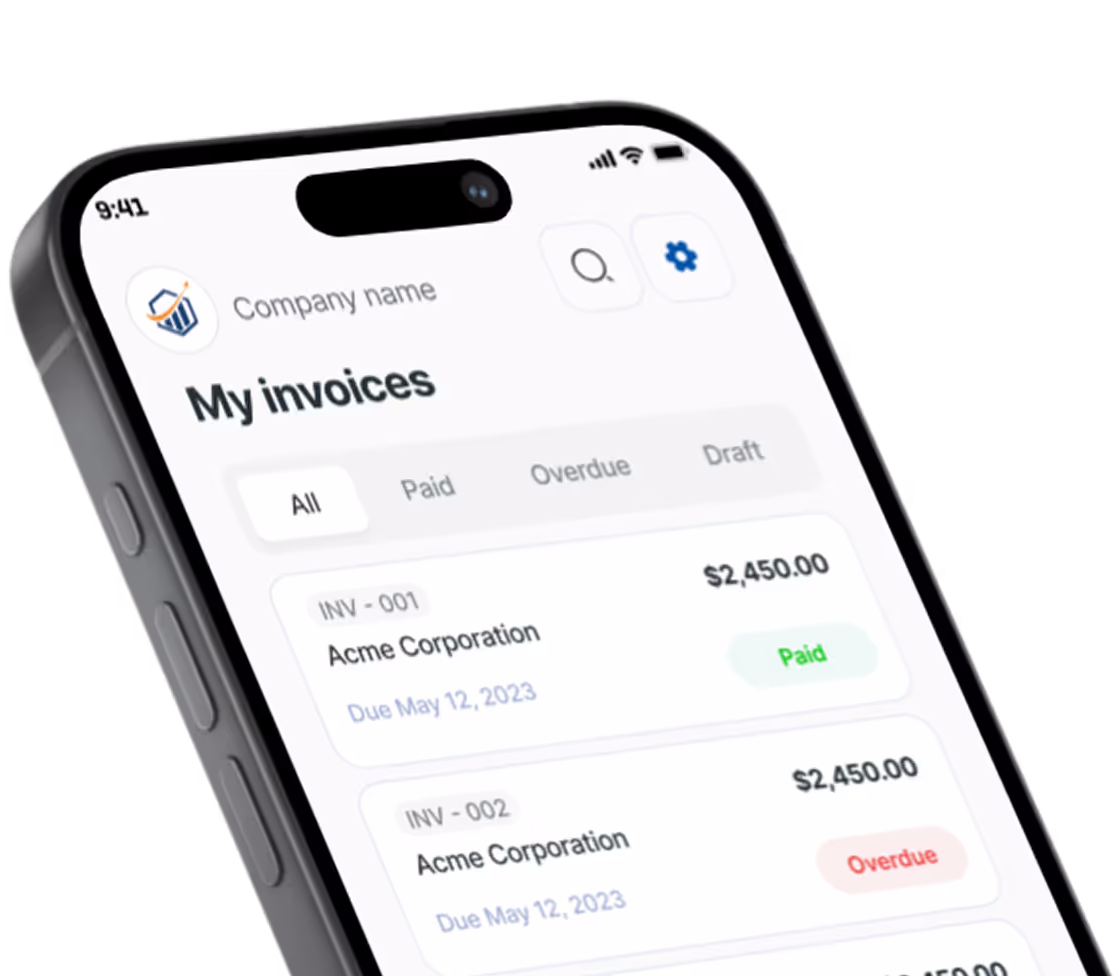
Pronto Invoice handles this with automated recurring invoicing. You set up the recurring schedule once per contract — client, line items, amount, frequency, payment method on file — and the invoices generate and send themselves on the schedule you set. When a customer signs a maintenance plan in March, you set up the recurring invoice once. The April invoice arrives in their inbox automatically. So does May, June, July. If you want to pause for a holiday, you pause. If you want to update pricing at renewal, you update once and every future invoice reflects it.
The cash side is automated too. Customers can save a payment method against the recurring schedule, so the monthly invoice gets paid the same day it is sent — no follow-up call, no AR aging on contract revenue. Combined with online payment links, a maintenance plan signed in March produces predictable monthly cash with effectively zero administrative overhead.
Two practical notes:
- Set up the recurring schedule the same day the contract is signed. Not “later this week.” The discipline of same-day setup is what makes a 200-contract program survive on a one-person back office.
- Automated retry on failed payments. Cards expire. Banks decline. A good recurring invoicing setup retries automatically on failure and notifies you only if it cannot collect after multiple attempts. You do not want to be manually checking 200 monthly transactions for declines.
Without automated recurring invoicing, a contract program tops out at the number of invoices the owner has time to manually create. With it, the practical ceiling moves from 30 contracts to 300+, with the same back-office time.
Common Mistakes That Kill Contract Programs
Five patterns that show up repeatedly when contract programs fail:
- Underpricing the first contracts. The first 10 customers should not be the cheapest. Founding-rate discounts of 10-15% are reasonable; 50% off is a margin trap that follows those customers for years.
- No renewal cadence. Contracts that auto-renew silently with no annual customer touch. The customer forgets they have you. When something breaks, they call whoever they Googled. Schedule one annual touch — a renewal letter, a year-end summary, a small gift to long-time customers.
- Scope creep without price adjustment. “Could you also look at the…” creep that turns a 60-minute tune-up into a 90-minute visit. Either the scope is in the contract or it gets billed separately. Pick a side and enforce it.
- No price escalation clause. Inflation eats your margin. A contract signed at $99/month in 2022 should not still be $99/month in 2026 unless you have specifically chosen that. Annual renewal is your built-in opportunity to raise your prices — and the price escalation clause in your contract is what makes that conversation easy.
- Mixing contract revenue and one-time revenue in one P&L line. You cannot manage what you cannot see. Track recurring revenue as its own line. The MRR (monthly recurring revenue) number is the most important number in a service business with contracts. Watch it weekly.
Most service businesses that successfully build a contract book look back and say the same thing: they wish they had started two years earlier. The compounding effect of recurring revenue is real and underappreciated. Year one feels slow. Year three is a different business.
Building Recurring Revenue That Pays You in February
The seasonal cash flow problem in service trades is a structural problem, and it has a structural solution. Maintenance contracts are not a marketing tactic — they are a business-model decision.
If you sell 5 contracts a month at $99/month, you add $5,940 of annual recurring revenue every month. Year one ends with about $30,000 of ARR. Year two is $90,000. Year three is $180,000. By year three the business is no longer seasonal.
Start with the customers who already trust you. Price honestly with route density in mind. Use clear, lawyer-reviewed contract terms. Auto-renew with proper notice. And whatever the contract scope is, do not let the billing side of it eat your week.
Ready to make recurring revenue actually recurring? Set up automated recurring invoicing in Pronto Invoice and let the monthly billing run itself.
There is always something more to read

Best Business Review Sites for Small Business (2026 Guide)
Which review sites drive calls, how to ask for reviews, respond to negatives, and avoid review gating penalties.

Client Onboarding for Service Businesses: A Complete Process Guide
Build a client onboarding process for your service business with welcome emails, intake forms, and payment setup.

CRM for Small Business: Do You Actually Need One? (2026 Guide)
Honest CRM guide for small business: when a spreadsheet works, signals to upgrade, key features, and avoiding overbuying.