Self-Employment Tax Explained: What Freelancers Actually Owe
Self-employment tax is the 15.3% Social Security and Medicare bill freelancers pay. Here's how it works.


The first time you see “self-employment tax” on a tax return, the math feels like a typo.
You earned $60,000 freelancing. You expected to owe federal income tax on that — fine, that part you knew. Then your tax software adds another line that says you owe roughly $8,478 on top, and the line item is called “self-employment tax.” You never saw this on any W-2 job. Where did it come from, and why is it so big?
This post answers that question without the jargon. We cover what self-employment tax actually is, the 15.3% rate, how it interacts with regular income tax, what to send the IRS each quarter to avoid an April surprise, and a few legal moves that can shrink the bill once your income is high enough to justify them.
One important caveat up front: this is general educational information, not tax advice. Tax situations vary, the rules change, and the dollar thresholds get adjusted most years. Run anything material past a CPA or enrolled agent before you act on it.
What Is Self-Employment Tax?
Self-employment tax is Social Security and Medicare tax for people who work for themselves.
When you have a W-2 job, your employer withholds 6.2% of your paycheck for Social Security and 1.45% for Medicare — that is “FICA” on your pay stub. Then your employer matches those numbers and sends both halves to the IRS. You only ever see your half, so it feels like the total cost is 7.65%. It is not. The total cost is 15.3%, and your employer is silently paying the other half on your behalf.
When you go independent, the IRS does not lose interest in collecting the full 15.3%. There is no employer to pay the other half, so you pay both halves yourself. That is the entire mystery of self-employment tax. Same Social Security and Medicare program, same total rate — you are just on the hook for all of it directly.
Per the IRS, the combined self-employment tax rate is 15.3%, made up of 12.4% for Social Security and 2.9% for Medicare (IRS — Self-Employment Tax). It is reported on Schedule SE and attaches to your Form 1040.
Two important wrinkles before we run numbers:
- The 12.4% Social Security portion only applies up to the annual Social Security wage base. That number changes every year — check the current year’s figure on IRS.gov before you file. Income above the wage base is not subject to the Social Security portion.
- The 2.9% Medicare portion has no cap. It applies to every dollar of self-employment net earnings.
- High earners may also owe an Additional Medicare Tax of 0.9% above certain thresholds (different for single vs. married filers). Most freelancers will not hit it; those who do should plan for it.
Who Has to Pay Self-Employment Tax?
If your net self-employment earnings are $400 or more for the year, you owe self-employment tax and must file Schedule SE with your Form 1040.
This threshold is lower than the general income-tax filing threshold. You can owe self-employment tax even when your income-tax bill is zero — if credits and deductions wipe out your income tax liability, the 15.3% on net profit still applies separately.
Who this covers:
- Freelancers and independent contractors — any 1099-NEC income from clients
- Sole proprietors — business income reported on Schedule C
- Single-member LLC owners (taxed as sole proprietors by default)
- Side hustlers — if your side income clears $400 net after expenses, you owe SE tax on it even if you also have a W-2 job
One nuance for people with both a W-2 and freelance income: the Social Security wage base applies to your combined wages. If your W-2 salary already pushed you past the annual Social Security wage base, only the 2.9% Medicare portion applies to your self-employment earnings. The 12.4% Social Security portion is not double-charged. Check the IRS website for the current year’s wage base before filing.
Self-Employment Tax vs. Income Tax — Two Separate Bills
This is the part that surprises people most. Self-employment tax and federal income tax are separate taxes, calculated on different formulas, both due on the same Form 1040.
Here is the order of operations:
- Calculate net self-employment earnings. Take your gross 1099 / freelance revenue, subtract your legitimate business expenses (Schedule C). What is left is your net profit.
- Calculate self-employment tax. Multiply that net profit by 92.35% first (a quirk of Schedule SE), then by 15.3%. That is your SE tax.
- Calculate income tax. Take your net profit, subtract half of the self-employment tax you just calculated, then run the result through the regular federal income tax brackets along with any other income.
State income tax usually rides on top of the federal income-tax piece. A handful of states have no income tax. None of that affects the federal SE tax calculation.
If you only remember one thing: net profit gets taxed twice — once for SE tax, once for income tax — but the IRS gives you a partial offset on the second pass by letting you deduct half the SE tax.
How to Calculate Self-Employment Tax: A Worked Example
Sara is a freelance graphic designer. After expenses, she has $60,000 in net Schedule C profit for the year. She is single, takes the standard deduction, and has no other income.
Step 1 — SE tax base: $60,000 × 92.35% = $55,410
Step 2 — Self-employment tax: $55,410 × 15.3% = $8,477.73
That $8,478 (rounded) is the SE tax line on her return. It is the bill that did not exist when she was a W-2 employee.
Step 3 — Deductible half of SE tax: $8,478 ÷ 2 = $4,239
Sara gets to subtract that $4,239 from her income before calculating federal income tax. It is an “above-the-line” deduction — she gets it whether or not she itemizes.
Step 4 — Adjusted gross income for income tax: $60,000 − $4,239 = $55,761
Step 5 — Income tax (illustrative — current brackets and standard deduction change every year, so check the IRS for current figures):
After the standard deduction and any qualified business income deduction she may be eligible for, Sara’s federal income tax will land somewhere in the low five figures. Combined with the $8,478 of SE tax, her total federal liability is meaningfully higher than a W-2 employee earning the same gross.
The number freelancers usually quote — “set aside roughly 25-30% of your net income for taxes” — comes from this combined math. It is a rule of thumb, not a calculation. Your actual percentage depends on your state, deductions, filing status, and total income. But 25-30% is a reasonable starting buffer until you have a CPA modeling your specific situation.
A Second Example: $120,000 in Freelance Profit
Marcus is a freelance software developer with $120,000 in net Schedule C profit. Same single filer, same standard deduction.
SE tax base: $120,000 × 92.35% = $110,820
Self-employment tax (assuming the SE base is below the Social Security wage base for the year): $110,820 × 15.3% = $16,955.46
Notice what just happened. Marcus’s profit doubled compared to Sara’s, but his SE tax also roughly doubled — because both halves of the rate are flat. There is no progressive bracket on SE tax. Every dollar of profit (up to the Social Security wage base) gets the full 15.3%.
If Marcus’s profit pushed him above the Social Security wage base for the current year, the dollars above that ceiling would only get the 2.9% Medicare portion, not the full 15.3%. That is the only “break” the SE rate structure offers, and it kicks in at a level most freelancers will not hit early.
His deductible half: $16,955 ÷ 2 = $8,478.
His federal income tax then runs on $120,000 − $8,478 = $111,522 of adjusted gross income, before the standard deduction and any other adjustments.
Quarterly Estimated Payments — Form 1040-ES
The IRS does not want a year’s worth of taxes in one April lump sum. They want it as you earn — same as withholding works for W-2 employees.
For self-employed people, that means quarterly estimated payments filed using Form 1040-ES. The 2026 due dates are typical:
- Q1: April 15
- Q2: June 15
- Q3: September 15
- Q4: January 15 of the following year
Verify the current year’s exact dates at IRS.gov — they shift if the date falls on a weekend or holiday.
Each quarterly payment is meant to cover roughly one-fourth of your projected federal tax liability for the year — both income tax and self-employment tax combined. You can pay online via IRS Direct Pay or EFTPS, or mail a check with the 1040-ES voucher.
The penalty for under-paying is not catastrophic on small balances, but it accrues like interest. Most people avoid it by hitting one of the IRS “safe harbor” thresholds:
- Pay at least 90% of the current year’s tax, or
- Pay at least 100% of last year’s tax (110% if your prior-year AGI was over $150,000)
The second option is the one most freelancers use, because last year’s number is a known quantity. New freelancers without a prior-year tax bill should aim for the 90% rule and overshoot slightly in their first year.
What to Set Aside Each Time You Get Paid
The cleanest discipline for a self-employed person is to treat tax as a withholding item the moment money lands in your account.
A reasonable starting protocol:
- Open a separate savings account labeled “Taxes.” Not your operating account. Not your personal checking. A separate, named, hands-off account at a bank that pays interest while it sits.
- Each time a client invoice gets paid, transfer 25-30% of that payment into the Taxes account. Some freelancers go higher (up to 35%) to also cover state income tax in higher-tax states.
- Pay your quarterly estimate from that account. When April 15 / June 15 / September 15 / January 15 rolls around, the cash is already there. You are moving money from one account to the IRS, not scrambling.
The reason this works is psychological, not financial. Once the money has been swept out of the operating account, you stop spending it. Treating tax money as “your money” until you pay it is the single most common reason freelancers get caught short in April.
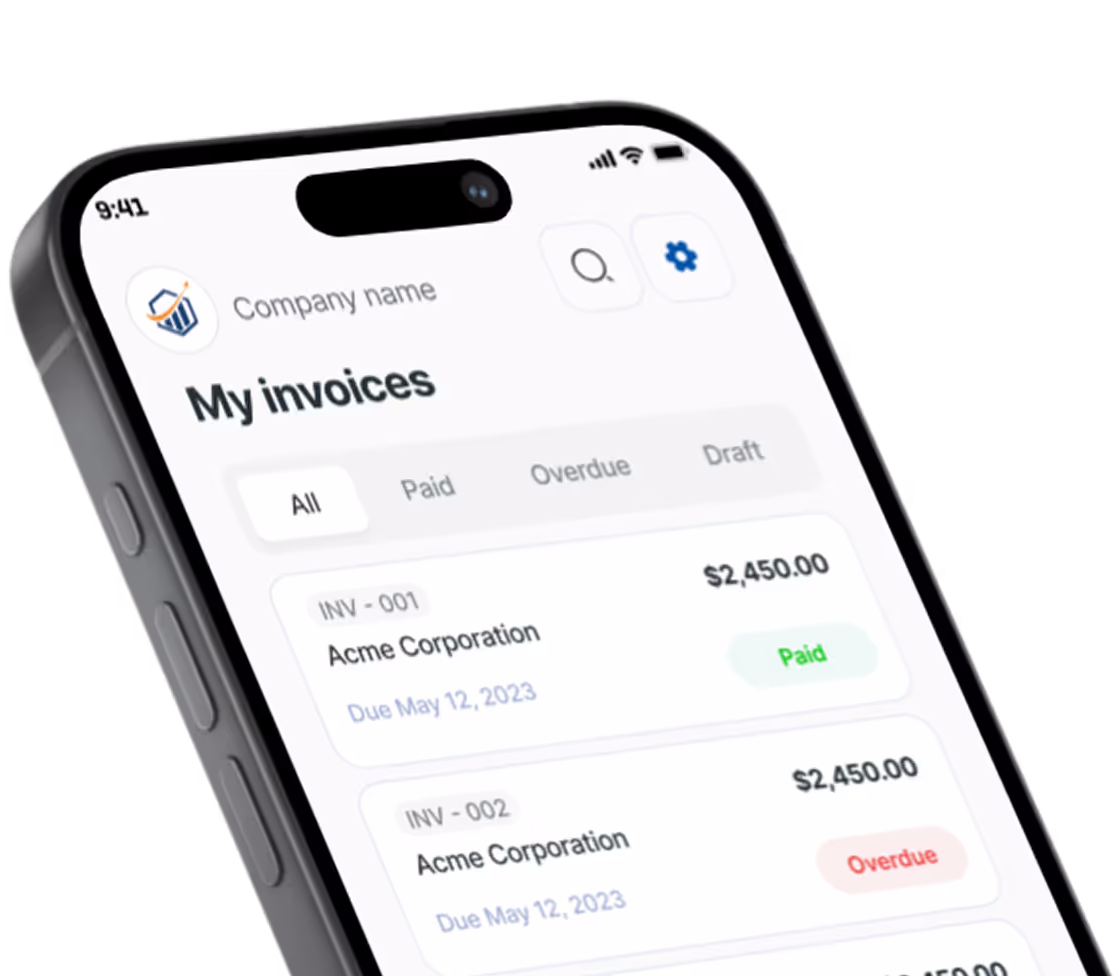
This is exactly the discipline Pronto Invoice’s real-time income tracking is designed to support. Every paid invoice updates a running total of net income for the period, so the 25-30% you should be sweeping is always visible — not something you reconstruct from a CSV in March. The point is not the dashboard; it is that you cannot accidentally spend tax money you can see in plain dollars.
The “Half of SE Tax” Deduction
This one comes up constantly because it sounds bigger than it is.
You can deduct half of your self-employment tax when calculating your federal income tax. That is the employer-equivalent portion — the IRS’s logic is that a real employer would have paid that half and gotten a deduction for it as a business expense. Since you are paying both halves, they let you deduct the employer half on the income-tax pass.
Two things this deduction does not do:
- It does not reduce your SE tax. The full 15.3% calculation still happens on its own line. The deduction only affects the income-tax calculation.
- It does not require you to itemize. It is taken on Schedule 1 as an “adjustment to income” and applies whether you take the standard deduction or itemize.
For Sara above, that deduction was $4,239. For Marcus, $8,478. Useful, but not a game-changer — it shifts the income-tax base, not the SE tax base.
Strategies to Legally Reduce Self-Employment Tax
Once your net profit gets meaningful, there are a few moves worth discussing with a CPA. None of these are “hacks.” They are real planning levers, and each one has trade-offs.
1. S-Corporation Election
If your business consistently nets six figures of profit, the most-discussed strategy is electing to have your LLC taxed as an S-corporation.
Here is the simplified version of why it can lower SE tax: an S-corp owner pays themselves a reasonable W-2 salary out of business profits, and the remaining profit flows through as a distribution that is not subject to self-employment tax. So instead of 15.3% applying to all $150,000 of net profit, it only applies to (say) the $80,000 W-2 salary — saving roughly 15.3% × $70,000 in SE tax.
The trade-offs are real and worth taking seriously:
- You have to run actual payroll (or pay a service to do it).
- The IRS expects the salary to be “reasonable” for the work — too low and they can challenge it.
- You file a separate Form 1120-S corporate return, not just a Schedule C, which usually means CPA fees go up.
- Some S-corp benefits (like the qualified business income deduction interaction) are nuanced and depend on your industry and total income.
The rule of thumb you will hear from CPAs is that the S-corp election starts to make sense somewhere around $60,000-$80,000 of consistent net profit, and clearly makes sense above $100,000. Below that, the payroll and CPA costs eat the savings. Run the actual math with a tax pro before electing — do not file an S-corp election because a YouTube video told you it saves 15.3%.
For a deeper look at how your business structure affects taxes, see our guide to LLC vs. sole proprietor vs. S-corp.
2. Maximize Legitimate Schedule C Deductions
The boring answer is also the most underused one. Every dollar of legitimate business expense reduces both your SE tax base and your income tax base. Home office (when you actually qualify), mileage on business trips, software subscriptions, professional development, business meals (50%), the business-use portion of your phone — these are not loopholes. They are how the system is designed to work.
The mistake freelancers make is the opposite of what people warn them about: not over-deducting, but under-deducting because the receipts are messy and they do not want to dig through them at year-end. A simple expense-tracking habit during the year catches deductions that are otherwise too small to bother reconstructing in April.
For a full breakdown of what qualifies, see our guide to business overhead expenses and how to track them.
3. Retirement Contributions
Retirement contributions do not directly reduce SE tax, but they reduce your income tax base, which is how most freelancers cut total federal liability.
The two most common vehicles:
- SEP-IRA — Allows contributions of up to roughly 25% of net self-employment earnings (with a calculation adjustment), up to an annual limit set by the IRS. Simple, no employee paperwork, deductible.
- Solo 401(k) — Has both an “employee” deferral and an “employer” contribution. Usually allows higher contributions than a SEP-IRA at moderate income levels. Slightly more setup, but the contribution limits are generous.
Check the IRS retirement plans page for the current year’s contribution limits. They get adjusted annually and you do not want to over-contribute.
The unsexy point: a SEP-IRA contribution of $10,000 does not save you 15.3%. It saves you whatever your marginal income tax rate is on that $10,000 — typically 12-24% federal for most freelancers, plus state. Still real money, just not SE-tax money.
4. Health Insurance Premium Deduction
If you pay your own health insurance premiums and your business shows a profit, you can deduct premiums for yourself, your spouse, and your dependents — above the line, no itemizing required. Like the half-SE-tax deduction, it lowers your income-tax base but not your SE tax base.
5. Qualified Business Income (QBI) Deduction
The QBI deduction allows many self-employed individuals to deduct up to 20% of qualified business income from taxable income — on top of the half-SE-tax deduction and above-the-line retirement contributions. It does not reduce self-employment tax directly, but it can meaningfully cut the income-tax portion of your total bill.
Eligibility phases out at higher income levels and is restricted for certain service businesses (attorneys, consultants, and financial services are subject to income limits). Run the numbers with a CPA — it is one of the more impactful deductions available for freelancers in the right income range.
Common Self-Employment Tax Mistakes
A short field guide to mistakes that show up in r/tax and CPA office hours every spring:
- “I had a slow year, so I do not have to file a return.” If your net self-employment earnings were $400 or more, you owe SE tax and have to file Schedule SE. The income-tax filing threshold is higher; the SE tax filing threshold is $400. (IRS)
- “My client did not send me a 1099, so I do not have to report it.” You do. The 1099 is a reporting tool for the IRS, not a permission slip. Income is income whether documented on a 1099 or not.
- “I will figure out taxes at the end of the year.” This is how people end up owing $14,000 they do not have. Quarterly payments exist for a reason.
- Confusing SE tax with income tax. They are separate. You can owe SE tax even when your income tax bill is zero (if low-income deductions and credits zero out income tax but the 15.3% on net profit still applies).
- Skipping the “reasonable salary” rule on an S-corp. Paying yourself $20,000 W-2 on $200,000 of profit is the kind of thing that gets re-classified by the IRS, with penalties.
- Forgetting state self-employment / business taxes. Some states have additional levies on self-employed income beyond regular state income tax. Check your state’s rules.
- Poor record-keeping for Schedule C deductions. Undocumented expenses get disallowed. Know how long to keep your business records and keep a running log throughout the year — not a year-end scramble.
What to Do This Week
If you are reading this in March or April, the moves are different than if you are reading it in July. A short triage:
If your tax filing is coming up:
- Compile your 1099s, your bank deposit records, and your expense receipts. The bank record matters more than the 1099s — gross deposits are what the IRS will compare against.
- Run a draft return through tax software before you make decisions. Knowing the actual number stops most tax-season panic.
- If the bill looks unmanageable, file on time anyway and use the IRS installment agreement. Penalties for filing late are worse than penalties for paying late.
If you are mid-year:
- Check whether you have made your quarterly estimates so far. If you missed one, the catch-up payment goes in this quarter.
- Set up the separate “Taxes” savings account if you have not already.
- If your net profit is trending toward six figures, schedule a 30-minute consult with a CPA now, not in March. S-corp elections need to be filed early in the year to apply for that year.
If you are just starting out:
- Open the savings account. Sweep 25-30% of every paid invoice into it from day one.
- File a Form 1040-ES voucher this quarter even if you guess on the amount. Starting the discipline is more important than nailing the number in year one.
- Track your income and expenses in real time, not in a year-end CSV scramble. The 30 seconds it takes to log a paid invoice and a deductible expense the day they happen will save you a 12-hour weekend in April. A chart of accounts for your freelance business makes that tracking faster and less painful.
Frequently Asked Questions About Self-Employment Tax
What is the self-employment tax rate? The self-employment tax rate is 15.3% — 12.4% for Social Security and 2.9% for Medicare. You calculate it on 92.35% of your net self-employment earnings, not the full gross amount.
Do I owe self-employment tax if I only made a little money freelancing? Yes, if your net self-employment earnings are $400 or more in a year, you owe SE tax and must file Schedule SE. This applies even if your total income is low enough that you owe no federal income tax.
Is self-employment tax the same as income tax? No. They are two separate taxes on the same return. Self-employment tax covers Social Security and Medicare. Income tax is the federal (and state) tax on your earnings. Both apply to self-employment income, but they are calculated separately and the formulas differ.
Can I deduct self-employment tax? You can deduct half of your self-employment tax as an above-the-line deduction on your federal income tax return. This reduces your taxable income but does not reduce the SE tax itself.
When are quarterly estimated tax payments due? For most years: April 15, June 15, September 15, and January 15 of the following year. Verify the current year’s exact dates at IRS.gov, as they shift when the date falls on a weekend or federal holiday.
How do I reduce self-employment tax legally? The main strategies are: (1) maximize Schedule C business expense deductions, which reduce the net profit SE tax is calculated on; (2) elect S-corporation status once net profit is consistently above roughly $60,000-$80,000; and (3) contribute to a SEP-IRA or Solo 401(k), which reduces income tax (not SE tax directly).
The Quiet Pronto Invoice Connection
This is not a sales pitch. The reason we built Pronto’s real-time income tracking the way we did is that the people who get blindsided by SE tax are not lazy — they are busy running a business and reconstructing financial reality after the fact.
When every paid invoice updates your year-to-date income, your projected SE tax base, and the running total of what should be in the Taxes savings account, the quarterly estimate stops being a guess. You glance at the dashboard, send the IRS the number, and go back to your actual job. That is the entire feature. It is not magic. It just turns a once-a-quarter scramble into a once-a-quarter routine.
The math of self-employment tax is fixed. The 15.3% is the 15.3%. What you control is whether you see it coming.
Sleep on the strategies. Talk to a CPA before electing an S-corp or maxing a Solo 401(k). And from the next invoice you collect, sweep the 25-30%.