
Electrical Invoice Template
Create professional electrical invoices in under 60 seconds. Download free templates or use Pronto Invoice's mobile app. Get paid faster on every job.
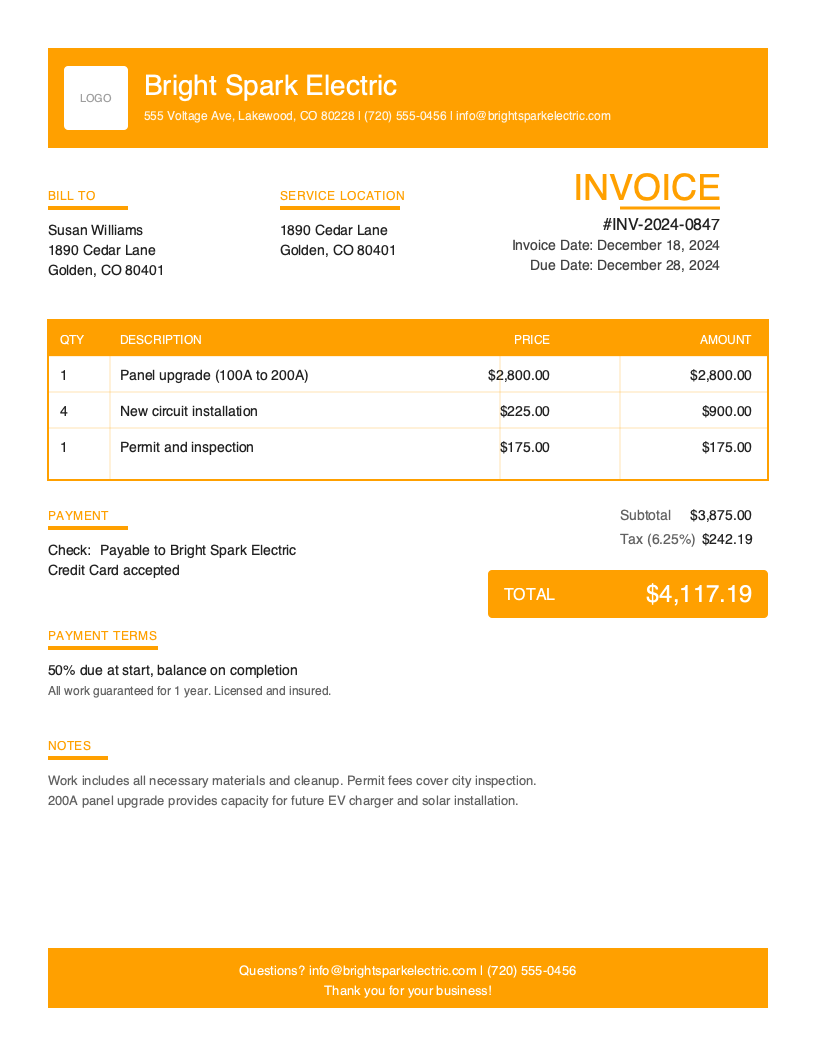
Download Free Electrical Invoice Template
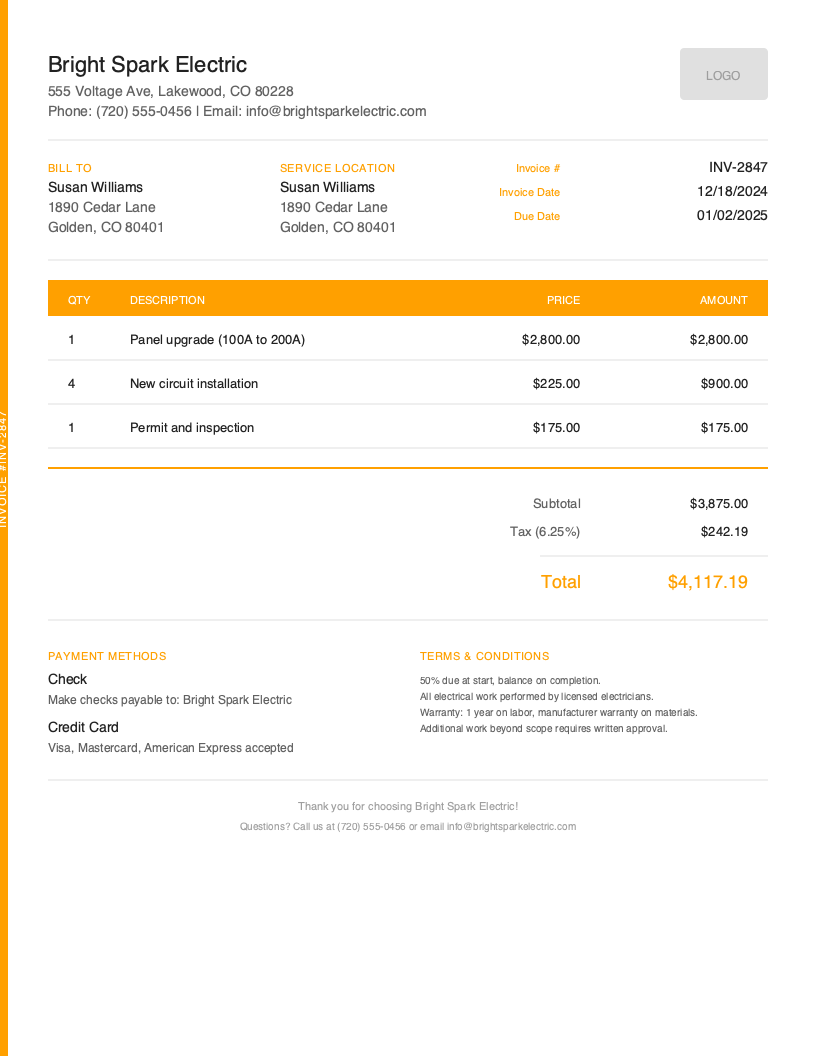
Get Your Free Electrical Invoice Template
Download in your preferred format. Customize with your logo, colors, and business details. Start invoicing professionally in minutes.
Microsoft Word
Easy to customize, add your logo
Microsoft Excel
Auto-calculate totals and taxes
Electrical Invoice Template Variations
Choose from multiple professional designs. Customize colors, add your logo, and make it yours.
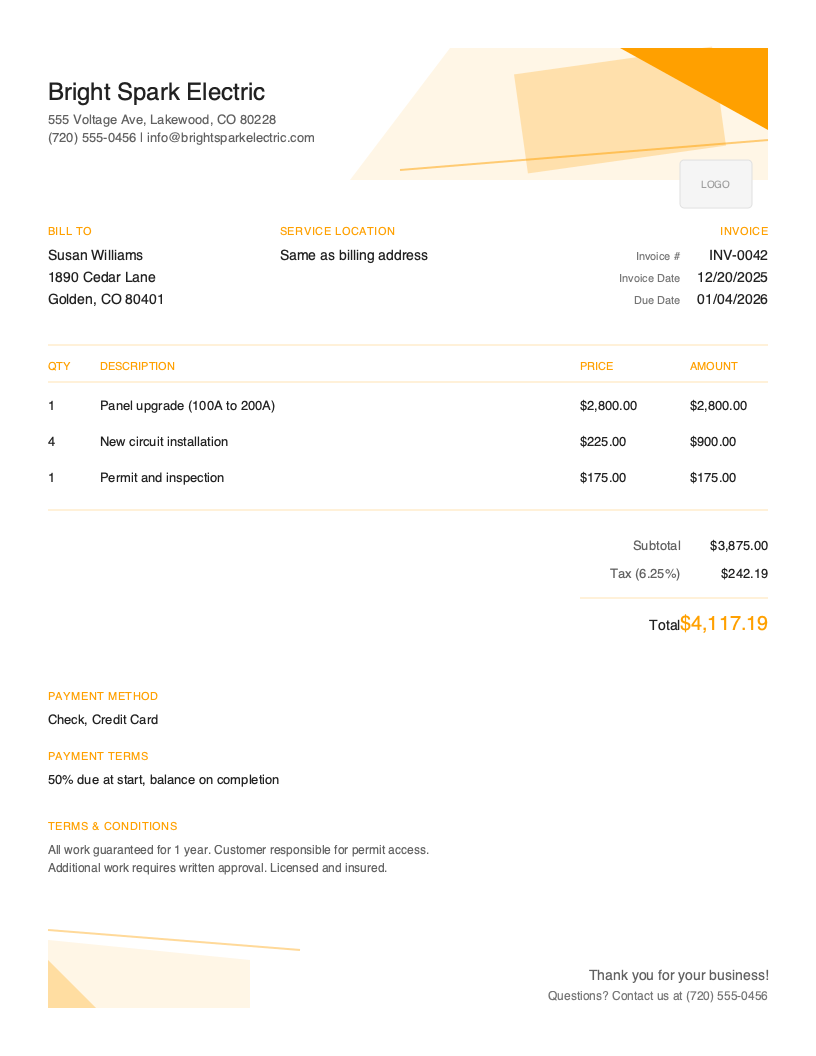
Artistic
Creative accent design
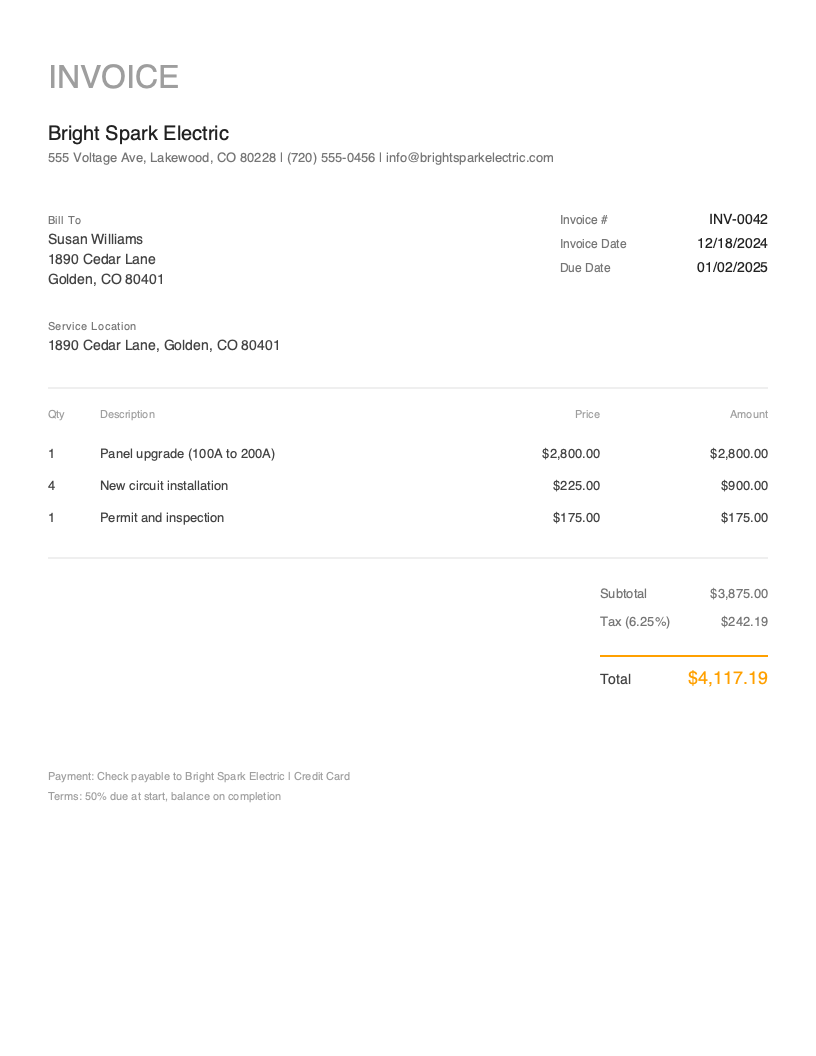
Classic
Traditional professional look
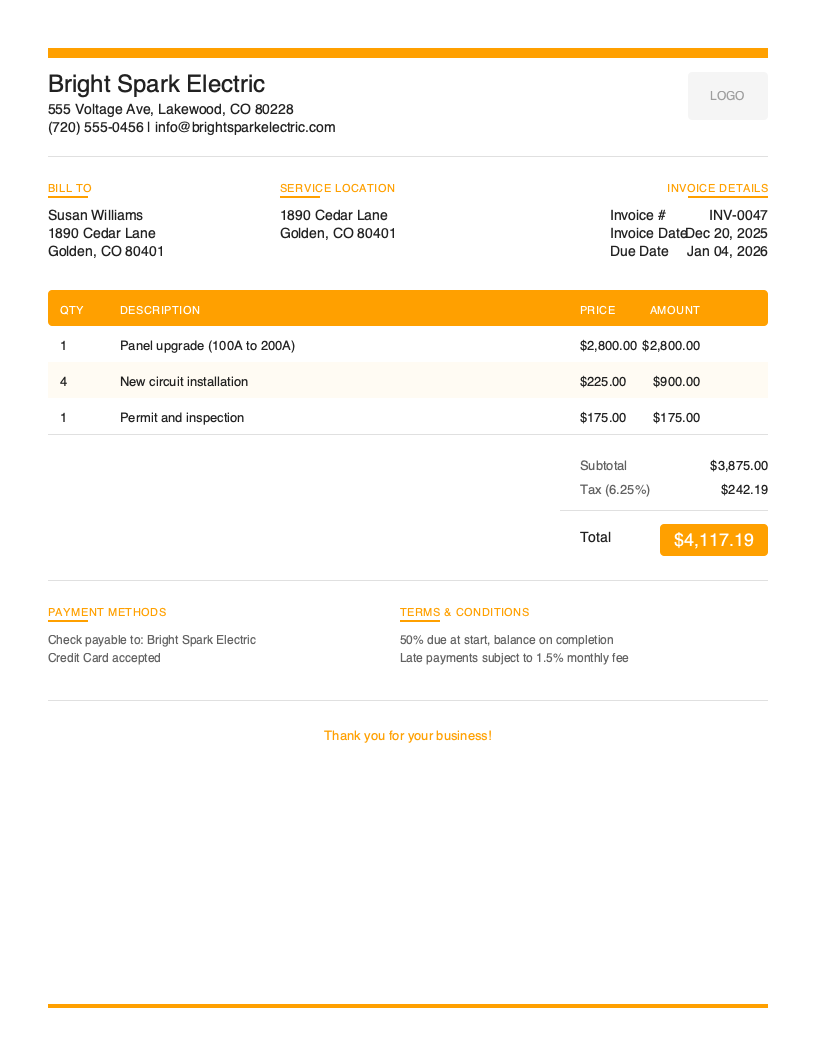
Modern
Clean contemporary style
No signup required. Create and download instantly.
You just finished a three-hour panel upgrade in a cramped garage. Your hands are covered in wire dust, the homeowner is waiting, and you need to get to your next call across town. The last thing you want to do is sit in your van for twenty minutes creating an invoice from scratch.
Yet professional invoicing is not optional for electricians. Your license number must appear on every invoice in most states. Permit numbers need documentation for code compliance. Materials and labor require separation for tax purposes. One poorly formatted invoice can delay payment for weeks—or worse, create liability issues during an inspection dispute.
What You’ll Find on This Page
- Free downloadable electrical invoice templates (PDF, Word, Excel, Google Docs)
- Complete breakdown of what every electrical invoice must include
- Industry-specific best practices for electricians and electrical contractors
- Answers to common electrical invoicing questions
- How Pronto Invoice helps electricians invoice on-site and get paid faster
Download Free Electrical Invoice Templates
Choose your preferred format and start invoicing immediately. Each template includes electrical-specific fields for license numbers, permit tracking, circuit documentation, and proper materials/labor separation. Excel and Google Sheets versions include built-in formulas for calculating labor rates, materials markup, and permit fee pass-through.
What to Include on an Electrical Invoice
A professional electrical invoice must meet both business requirements and legal compliance standards. Unlike general service invoices, electrical work invoices need specific documentation for licensing, permits, and code compliance.
Required Invoice Sections
Invoice Identification - Links to permits, work orders, inspection reports for traceability.
Business Information - Electrician license number, insurance, bonding—legally mandated in most states.
Client Information - Property owner, property manager, or general contractor billing details.
Job Site Address - Service location for permits, inspections, and warranty claims.
Line Items Breakdown - Labor hours, materials, fixtures, permit fees—itemized for transparency.
Circuit/Panel Details - Documents specific work for safety records and future reference.
Pricing Summary - Subtotals, markup, trip charges, permit pass-through costs.
Tax Information - Materials typically taxed; labor often exempt—separation required.
Permit Numbers - Required for permitted work; links invoice to approved electrical permits.
Payment Methods - Multiple options accommodate job sizes from service calls to renovations.
Terms & Conditions - Warranty coverage, code compliance statements, liability limitations.
Electrical-Specific Fields Explained
Electrician License Number - Most states require your license number on all invoices, estimates, and contracts. This is a legal requirement that protects both you and your customer. Include your license prominently near your business information.
Permit Numbers and References - For permitted work, reference the permit number to create a paper trail linking your work to the approved permit. Document permit costs separately.
Circuit and Panel Information - Document specific work performed: circuits added or modified, panel upgrades, amperage changes, breaker installations. This serves as a permanent record.
Materials vs. Labor Separation - Tax laws in most states treat these differently. Separating line items ensures proper tax calculation and helps during warranty claims.
Service Call and Trip Charges - Show service call fees as separate line items. Common structures include flat trip charges, minimum service call fees, or diagnostic fees.
Understanding Electrical Contracting Industry Invoicing
The U.S. electrical contracting industry represents approximately $200 billion in annual revenue, employing over 700,000 electricians across residential, commercial, and industrial sectors.
Residential Service and Repair - Service electricians handle outlet replacements to panel upgrades. Invoices involve service call fees, hourly labor, and materials markup. Payment often expected at completion.
Commercial Electrical Services - Invoices may go through accounts payable with net-30 terms. Purchase order numbers and project references become essential.
Industrial Electrical - Projects involve progress billing, detailed documentation, and complex approval processes.
New Construction - Invoices must align with draw schedules, include lien waiver documentation, and reference contract terms for change orders.
Why Professional Invoicing Matters
Your invoices serve as legal documents that prove you are licensed and insured, document permitted work, create warranty documentation, establish enforceable payment terms, and demonstrate code compliance.
Electrical Invoicing Best Practices
Include Your License Number on Every Invoice
This is non-negotiable. Most state licensing boards require your electrical contractor license number on all invoices. Place it prominently with your business information.
Document Permit Numbers and Inspection Status
Reference permit numbers on your invoice for permitted work. Note inspection status: permit pulled, rough-in passed, final pending, or inspection complete.
Separate Materials and Labor for Tax Purposes
Most states tax electrical materials but exempt labor. Separate these clearly on every invoice for proper tax calculation and transparency.
Itemize Fixtures and Equipment with Model Numbers
Include manufacturer names and model numbers when installing fixtures, panels, breakers, or equipment. This creates records for warranty claims.
Document Circuit Details for Customer Records
Note which circuits were added, modified, or repaired. Include breaker positions, amperage ratings, and what each circuit serves.
Include Clear Warranty Terms
Specify what your warranty covers (typically workmanship), for how long (one year standard), and what it excludes. Warranty terms on your invoice create enforceable expectations.
Charge Appropriate Service Call Fees
Show trip charges or diagnostic fees as separate line items. Transparency builds trust and reduces payment disputes.
Create Electrical Invoices in Under 60 Seconds
Pronto Invoice was built for electricians who need to invoice on-site. Our mobile-first approach means you create professional invoices from your phone in five simple steps:
- Select Client - Choose from saved contacts or add new ones in seconds
- Add Line Items - Labor, materials, trip charges with automatic calculations
- Set Payment Info - Due dates, accepted methods, terms
- Add Job Details - License number, permit references, circuit documentation
- Review and Send - Email or print instantly
Features Electricians Need
Offline Capability - Works in basements, crawl spaces, and commercial buildings with zero connectivity. Syncs automatically when back online.
License and Permit Tracking - Store your license number and add permit references to any invoice.
Materials/Labor Separation - Built-in line item categories ensure proper tax handling.
Service Call Fee Templates - Add standard trip charges with one tap.
Fixture Catalogs - Save commonly-used items with descriptions and pricing.
Photo Attachments - Attach before/after photos directly to invoices.
Payment Processing - Accept credit cards, ACH transfers, and digital payments. Clients pay with one click.
Electrical Invoicing Best Practices
Include Your License Number on Every Invoice
Most state licensing boards require your electrical contractor license number on all invoices. Place it prominently with your business information.
Document Permit Numbers and Inspection Status
Reference permit numbers on invoices for permitted work. Note inspection status: permit pulled, rough-in passed, final pending, or complete.
Separate Materials and Labor for Tax Purposes
Most states tax electrical materials but exempt labor. Separate these clearly to ensure proper tax calculation and demonstrate transparency.
Itemize Fixtures with Model Numbers
Include manufacturer names and model numbers for panels, breakers, and fixtures. This creates records for warranty claims and future matching.
Include Clear Warranty Terms
Specify what your warranty covers (typically workmanship), duration (one year standard for labor), and exclusions on every invoice.
Frequently Asked Questions
Every electrical invoice should include your business information, electrician license number, invoice number and date, client billing information, job site address, itemized labor and materials (listed separately), permit numbers for permitted work, pricing summary with taxes, payment terms, and warranty information.
Most electricians pass permit fees through to customers at cost or with a small administrative markup. List permit fees as a separate line item showing the permit number, issuing authority, and fee amount.
Generally, electrical materials are taxable while labor is exempt. This is why separating materials and labor matters. Some states tax the entire invoice if not separated. Check your state's specific requirements.
Related Invoice Templates
Start Creating Professional Electrical Invoices Today
Join thousands of professionals who use Pronto Invoice to get paid faster. Create your first invoice in under 60 seconds.
This guide is for informational purposes only and does not constitute legal or tax advice.