
Roofing Invoice Template
Download free roofing invoice templates for PDF, Word & Excel. Create professional invoices in 60 seconds with materials tracking.
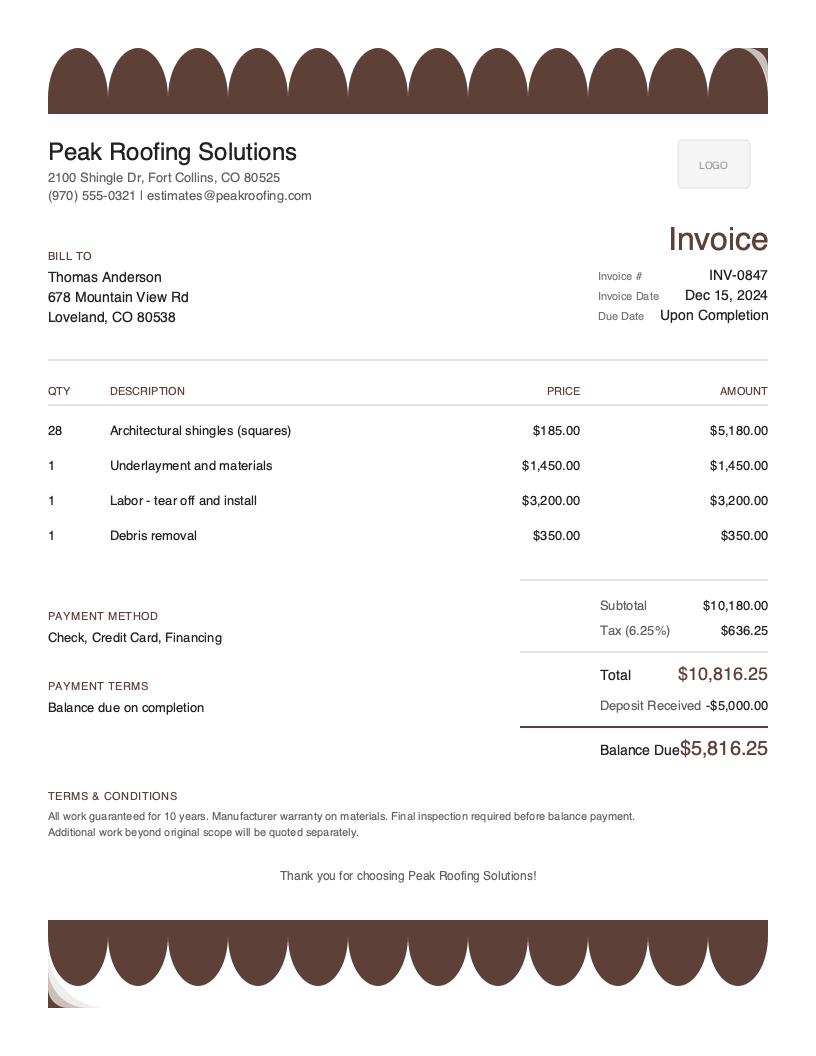
Download Free Roofing Invoice Template
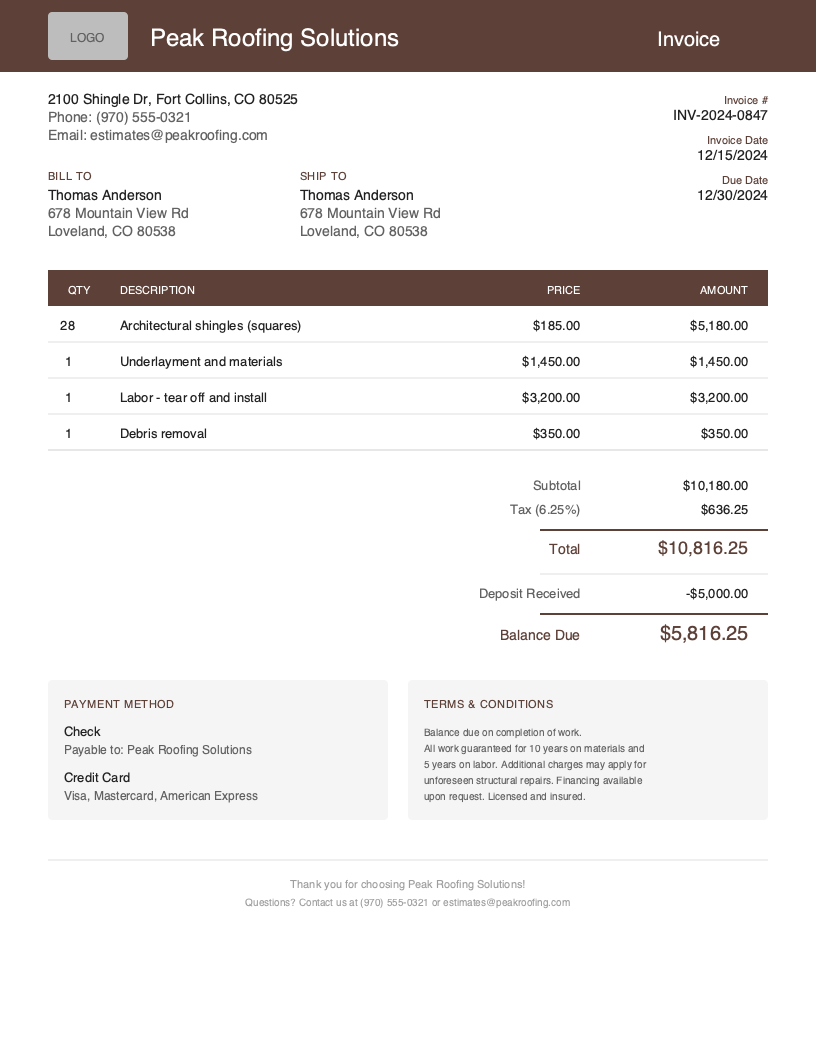
Get Your Free Roofing Invoice Template
Download in your preferred format. Customize with your logo, colors, and business details. Start invoicing professionally in minutes.
Microsoft Word
Easy to customize, add your logo
Microsoft Excel
Auto-calculate totals and taxes
Roofing Invoice Template Variations
Choose from multiple professional designs. Customize colors, add your logo, and make it yours.
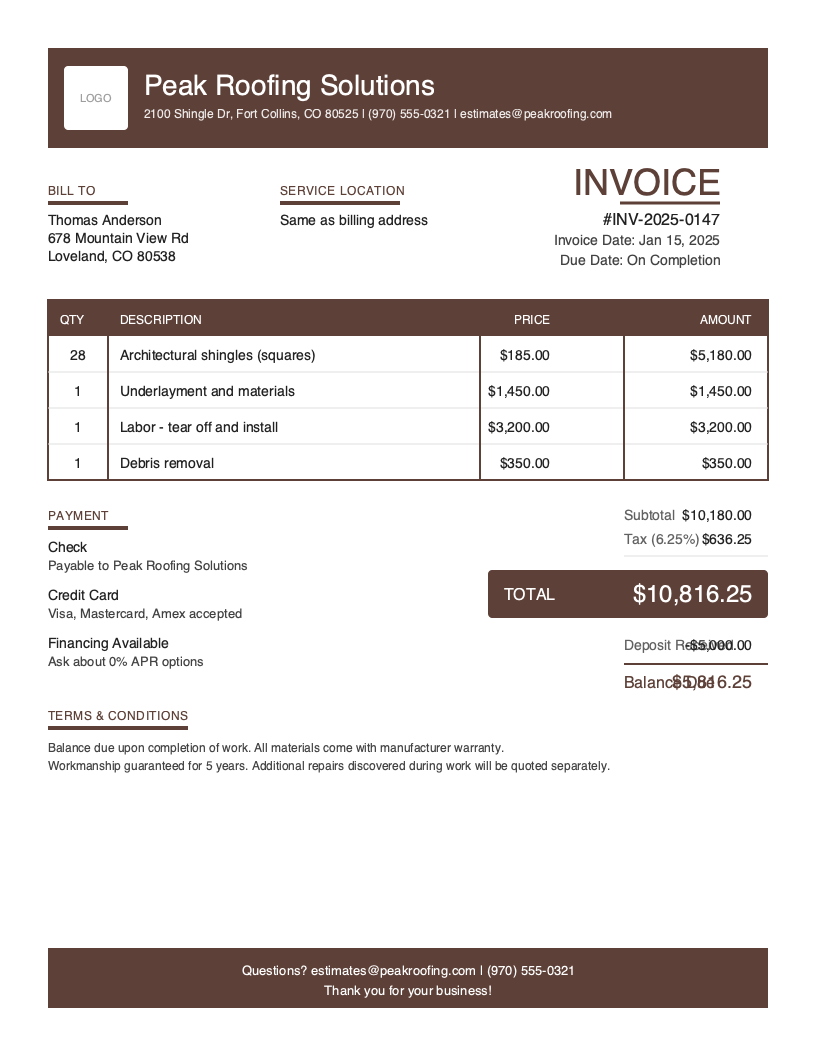
Bold
Bold and branded design
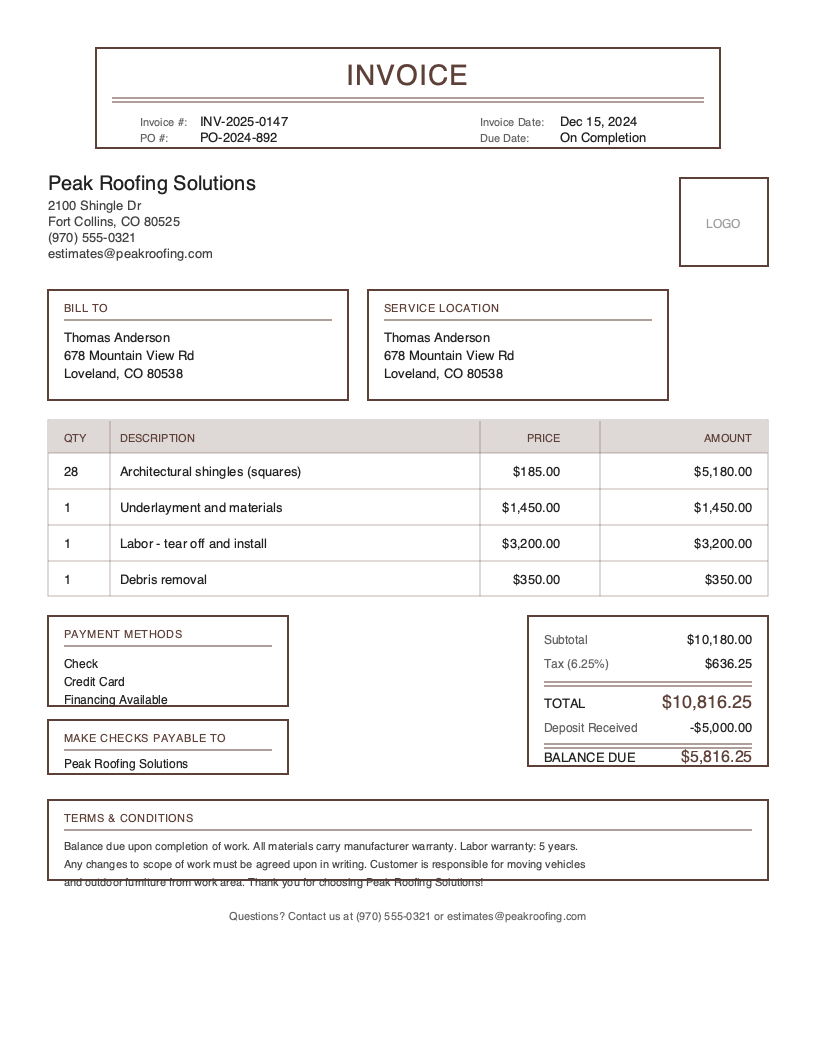
Classic
Professional classic design
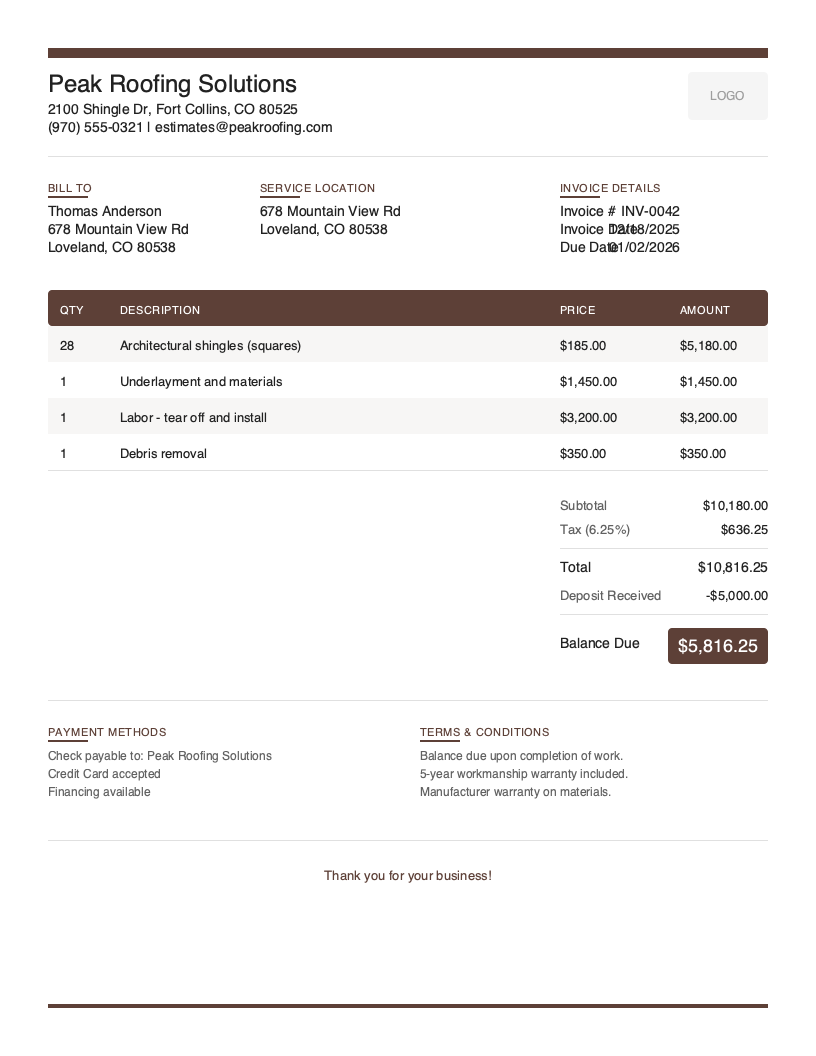
Modern
Modern clean design
No signup required. Create and download instantly.
You just finished inspecting a storm-damaged roof, the homeowner is anxious about their insurance claim, and they need detailed documentation today. You are standing on a ladder, your tablet is in the truck, and the insurance adjuster wants an itemized breakdown by tomorrow morning. This is the reality of running a roofing business.
Roofing invoicing presents challenges that generic billing tools cannot handle. Large project amounts requiring deposit tracking and progress payments. Material specifications that must match manufacturer warranty requirements. Job site addresses separate from billing addresses for insurance claim documentation. Square footage calculations using industry-standard roofing squares. Weather delays that extend project timelines and affect payment schedules.
Poor invoicing practices cost roofers thousands in delayed insurance payments, disputed material specifications, and warranty claim denials. When you are managing multiple job sites, coordinating crews, tracking material deliveries, and racing weather windows, your invoicing needs to be fast, professional, and comprehensive enough to satisfy insurance adjusters and protect your warranty obligations.
What to Include in a Roofing Invoice
Roofing invoices require more detail than standard service invoices. Insurance adjusters need documentation that matches their claim estimates. Homeowners need records for warranty registration. Commercial property managers need itemized breakdowns for budgeting and maintenance records.
Required Sections for Roofing Invoices
| Section | Required? | Why It Matters for Roofing |
|---|---|---|
| Invoice Identification | Required | Track jobs, link to estimates, contracts, and insurance claim numbers |
| Business Information | Required | Roofing contractor license, bonding, insurance, manufacturer certifications |
| Client Information | Required | Property owner billing details for insurance and warranty documentation |
| Job Site Address | Required | Property where roof work performed (critical for insurance claims) |
| Line Items Breakdown | Required | Materials, labor, tear-off, disposal, permits itemized separately |
| Pricing Summary | Required | Material costs, labor totals, project total matching estimate |
| Tax Information | Varies | Materials typically taxed; labor may be exempt depending on state |
| Deposit and Balance | Required | Track deposits received, progress payments, balance due at completion |
| Payment Methods | Required | Accept large payments via check, ACH, financing options |
| Terms and Conditions | Required | Warranty terms, weather delay policies, change order procedures |
Roofing-Specific Fields to Include
Job Site Address
Roofing projects occur at specific property locations that differ from where you send bills. Your invoice must clearly identify the job site address for insurance claims, manufacturer warranty registration, and permit records. Include the full street address, city, state, and ZIP code.
Deposit and Progress Payment Tracking
Roofing projects typically involve significant upfront material costs. Your invoice should document the deposit amount received, date, payment method, remaining balance, and payment schedule for larger projects.
Material Specifications
Insurance adjusters and warranty registration both require detailed material specifications. Document shingle manufacturer and product line, color selection, underlayment type, flashing specifications, ridge cap details, and any upgraded components.
Square Footage and Roofing Squares
The roofing industry measures work in squares, where one square equals 100 square feet. Document total roof area in both square feet and roofing squares, including waste factor applied (typically 10-15%).
Warranty Information
Every roofing invoice should specify warranty coverage: manufacturer warranty period and type, your workmanship warranty terms, and exclusions. Many manufacturer warranties require specific installation practices to remain valid.
Understanding Roofing Industry Invoicing
The Roofing Business Landscape
The U.S. roofing industry exceeds $50 billion in annual revenue, with residential re-roofing representing the largest segment. The industry encompasses storm damage restoration, scheduled residential re-roofing, new construction, commercial flat roof installation, and repair services.
Storm damage restoration represents a significant portion of revenue, particularly in regions prone to hail, hurricanes, and severe weather. Insurance claim work requires meticulous documentation and specific invoice formats matching adjuster estimates.
Residential re-roofing serves homeowners replacing aging roofs. These projects range from $8,000 to $25,000 for modest residential projects, with storm damage and commercial reaching substantially higher.
Commercial roofing involves flat roof systems, multiple buildings, and ongoing maintenance contracts requiring detailed documentation for budgeting and insurance purposes.
Why Professional Invoicing Matters for Roofers
At these dollar amounts, professional invoicing is not optional. Insurance adjusters need documentation matching their estimates line by line. Homeowners need records for warranty registration. Commercial clients need invoices satisfying their accounting requirements.
Cash flow management is critical. Materials represent substantial upfront costs you typically pay before receiving customer payment. Complete, accurate invoices accelerate the approval process for insurance claim work.
Create Roofing Invoices in Under 60 Seconds
Pronto Invoice’s mobile-first app is designed for roofing professionals who need to invoice from rooftops, job sites, and locations where cell signal is unreliable.
Built for Roofing Professionals
5-Step Invoice Creation
Create professional roofing invoices in 5 simple steps: select client, add line items, set payment details, add project information, review and send. Hand the homeowner a professional invoice before you pull out of the driveway.
Works Offline
Invoice from job sites with poor cell signal or rural properties. Create invoices, attach roof photos, record material specifications. Everything syncs automatically when you reconnect.
Roofing-Specific Features
- Deposit and progress payment tracking with running balances
- Photo documentation attached directly to invoices
- Material specification fields with manufacturer details
- Warranty period management and documentation
- Estimate-to-invoice conversion with one tap
- Square footage and roofing square calculations
Get Paid Faster
Accept credit cards, ACH transfers, and digital payments directly from your invoice. Faster payment means you can order materials sooner, schedule crews efficiently, and maintain healthy cash flow.
Roofing Invoicing Best Practices
Document Deposits and Progress Payments Clearly
Show deposit amount, date received, and payment method. Calculate and display the balance due prominently. For larger projects, create a payment schedule showing each milestone and payment status.
Itemize Materials with Detailed Specifications
Break out materials: shingles (brand, product line, squares), underlayment, flashing, ridge cap, starter strip, and ventilation components. Include model numbers for insurance and warranty documentation.
Include Job Site Address and Photo Documentation
The job site address must appear clearly on every invoice. For insurance claims, this must match the claim property exactly. Attach before/after photos to support claim approval.
Track Weather Delays and Change Orders
Document weather delays on invoices to explain timeline changes. Document mid-project changes as formal change orders with their own approval and pricing.
Specify Warranty Terms Prominently
Include manufacturer warranty type and duration, your workmanship warranty period, and any conditions or exclusions. Reference the specific products installed that carry warranty coverage.
Frequently Asked Questions
A professional roofing invoice should include: business info with contractor license and insurance, client billing info, job site address (critical for insurance), detailed line items separating materials, labor, tear-off, disposal, and permits, deposit amounts and balance due, payment terms, and warranty information.
Residential re-roofing typically requires 30-50% deposit at signing with balance due upon completion. Insurance claim work often follows: deposit at signing, payment when insurance check received, balance at completion. Commercial projects may specify Net 30 with progress billing.
Match your line items to the adjuster's estimate categories using the same terminology and measurements. Include the claim number, attach photo documentation of damage and repairs, show approved amounts, supplements, depreciation, deductible, and customer balance due.
Related Invoice Templates
Start Creating Professional Roofing Invoices Today
Join thousands of professionals who use Pronto Invoice to get paid faster. Create your first invoice in under 60 seconds.
This guide is for informational purposes only and does not constitute legal or tax advice.