
Towing Invoice Template
Download free towing invoice templates for PDF, Word & Excel. Create professional invoices in 60 seconds with mileage & fee tracking.
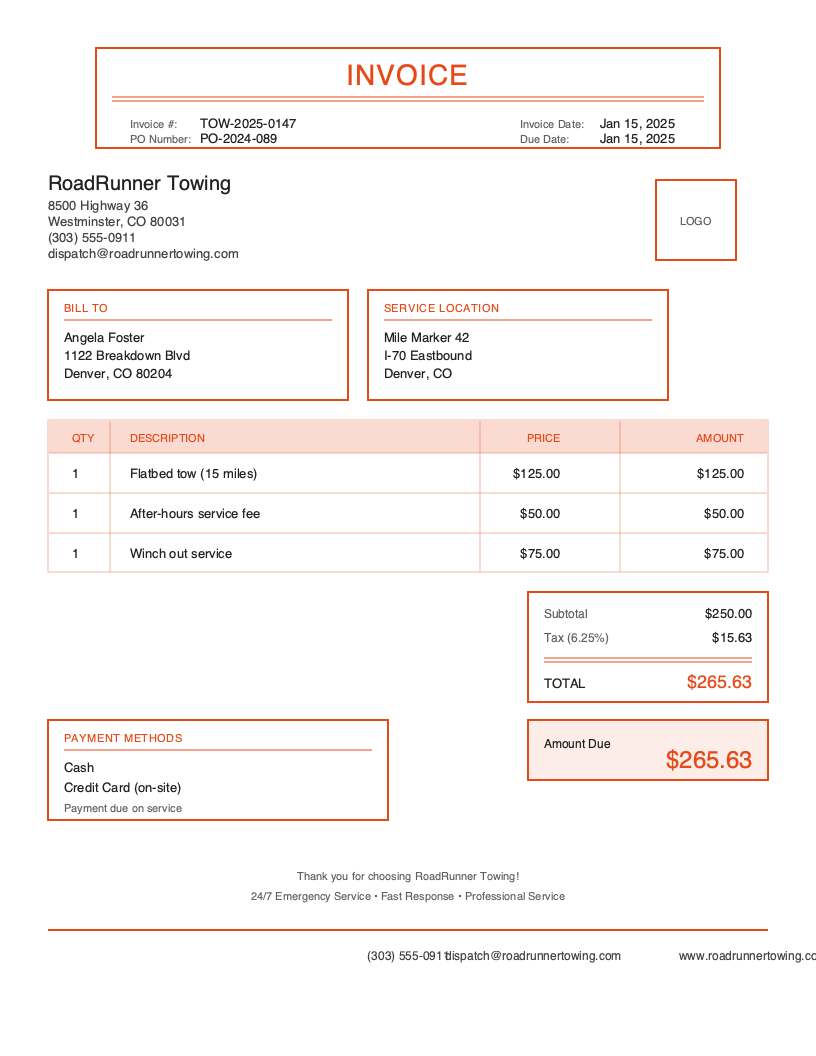
Download Free Towing Invoice Template
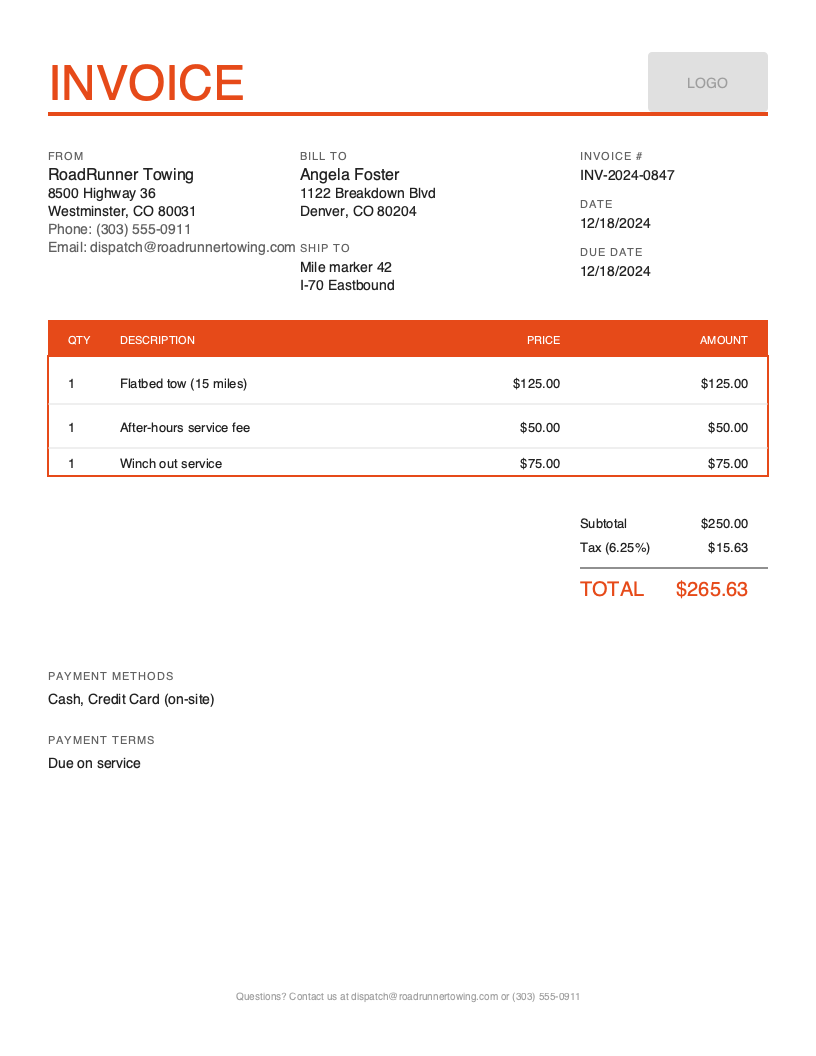
Get Your Free Towing Invoice Template
Download in your preferred format. Customize with your logo, colors, and business details. Start invoicing professionally in minutes.
Microsoft Word
Easy to customize, add your logo
Microsoft Excel
Auto-calculate totals and taxes
Towing Invoice Template Variations
Choose from multiple professional designs. Customize colors, add your logo, and make it yours.
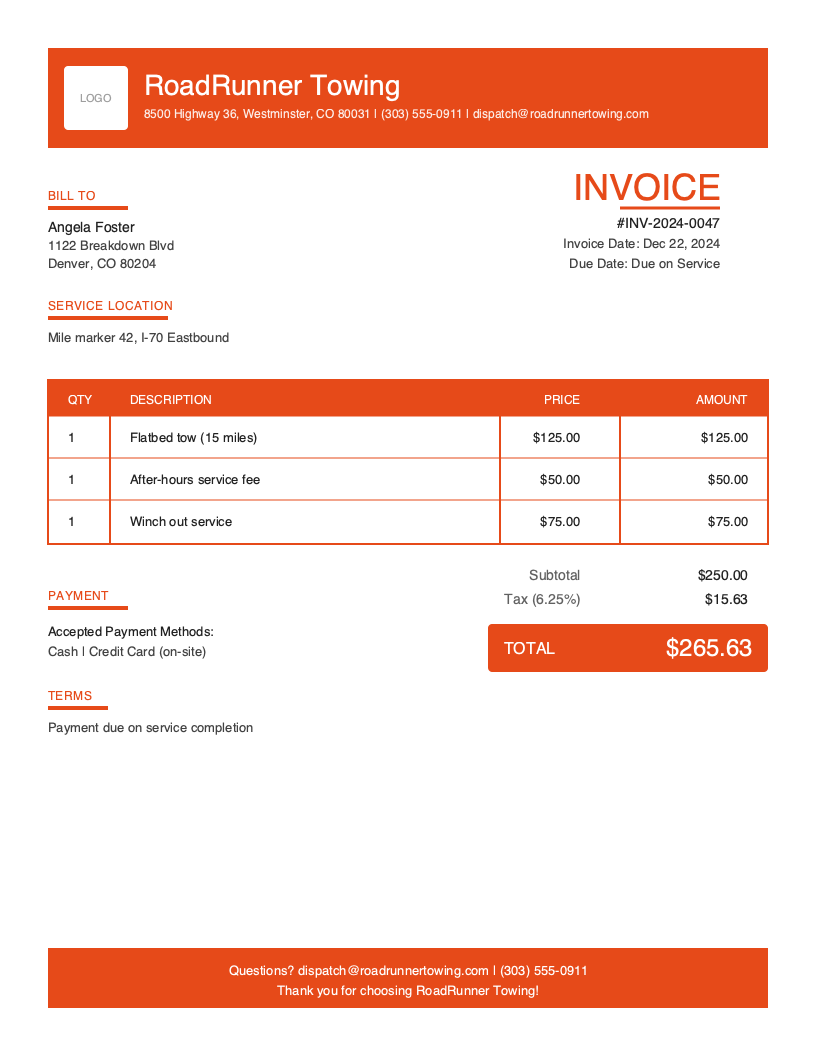
Bold
Bold and branded design
Classic
Professional classic design
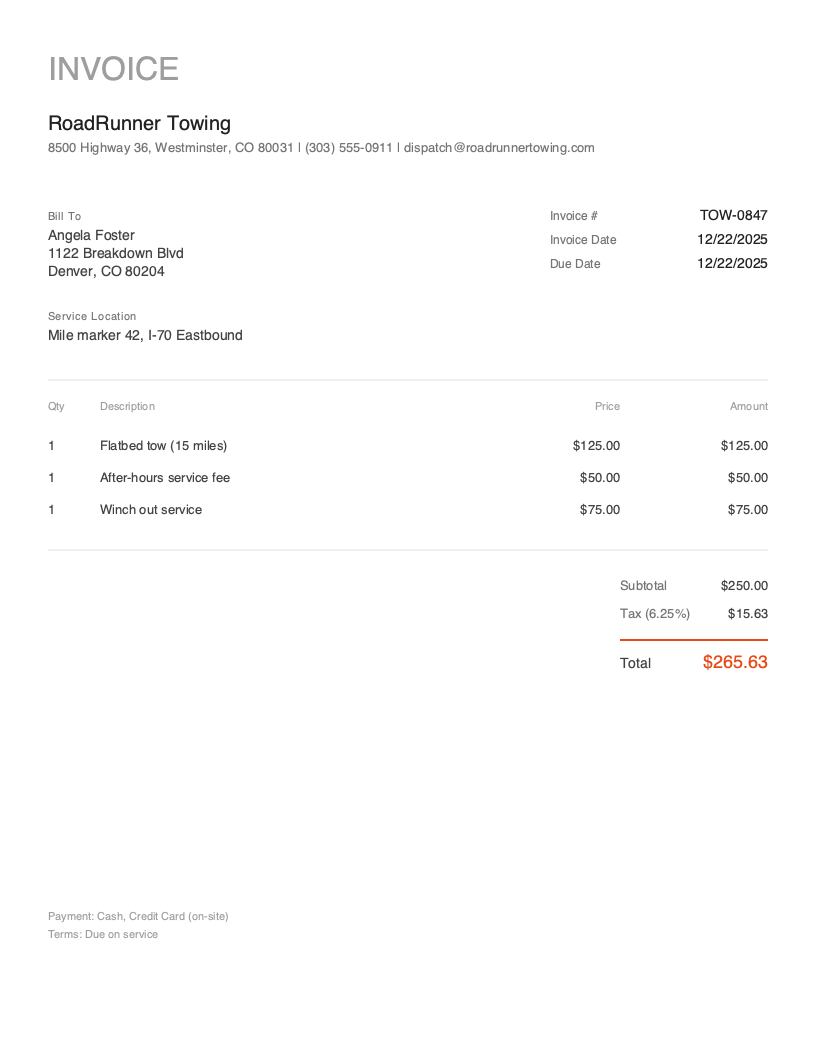
Minimal
Minimal utility design
No signup required. Create and download instantly.
You just completed a 2 AM recovery call on a dark highway shoulder. Rain is pelting your windshield, the vehicle owner is stressed about their disabled car, and you need to collect payment before the vehicle leaves your flatbed. Fumbling with carbon copy receipts or trying to remember prices is not an option.
The towing industry operates under unique pressures that generic invoicing simply cannot handle. Every tow requires precise documentation—pickup locations, drop-off destinations, mileage calculations, service types, and authorization references. Miss any detail, and you risk denied insurance claims, disputed impound fees, or legal complications with police-ordered tows.
For towing companies, professional invoicing is not just about getting paid. It is about creating legal documentation that protects your business. Insurance companies require itemized breakdowns. Motor clubs demand specific claim formats. Police departments expect accurate impound records.
What to Include on Your Towing Invoice
A complete towing invoice serves multiple purposes: payment collection, insurance documentation, impound records, and legal protection. Unlike standard service invoices, towing documentation must capture location data, vehicle details, and authorization information.
Required Invoice Sections
| Section | Required? | Why It Matters for Towing Services |
|---|---|---|
| Invoice Identification | Yes | Unique invoice number and date for tracking and reference |
| Business Information | Yes | Company name, DOT/MC numbers, license, insurance policy numbers |
| Customer/Vehicle Owner Info | Yes | Contact details for billing, follow-up, and lien notifications |
| Vehicle Information | Yes | VIN, make/model/year, plate, color for identification and claims |
| Pickup Location | Yes | Exact address or GPS coordinates where vehicle was recovered |
| Drop-off/Destination | Yes | Final delivery location, impound lot, repair shop, or customer address |
| Service Type | Yes | Light duty, medium duty, heavy duty, flatbed, winch-out, or roadside |
| Line Items (Fee Breakdown) | Yes | Itemized hookup, mileage, after-hours, winch, dolly, and service fees |
| Pricing Summary | Yes | Subtotals, additional charges, and total amount due |
| Tax Information | Varies | Sales tax requirements differ by state and service type |
| Payment Methods | Yes | Cash, credit card, fleet account, motor club billing options |
Critical Towing Invoice Elements
Vehicle Information
Complete vehicle identification prevents disputes and enables accurate insurance processing. Document the make, model, year, VIN (full 17 characters), license plate number with state, and exterior color. For damaged vehicles, note the general condition.
Pickup and Drop-off Locations
Record the full street address for pickup, or GPS coordinates for highway shoulders and remote areas. Note mile markers, cross streets, or parking lot names. The drop-off destination should be equally specific.
Mileage/Distance (Loaded Miles)
Most towing rates include a base hookup fee plus per-mile charge for loaded miles. Document both total trip distance and loaded miles separately if your rates distinguish between them.
Authorization/Dispatch Reference
Every tow should reference its authorization source. For motor club calls, include the claim number. For police-ordered tows, document agency name, officer badge number, and case number. For private property impounds, note property manager authorization.
Towing Industry Overview
The U.S. towing and roadside assistance industry generates approximately $8 billion in annual revenue, with over 50,000 towing companies operating nationwide.
Common Towing Business Models
Roadside Assistance and Motor Club Services represent significant revenue for many companies. These calls require specific invoicing formats and claim numbers for reimbursement.
Police Rotation and Municipal Contracts involve regulated rates and documentation requirements. Detailed invoicing is essential for municipal billing and impound fee collection.
Private Property Impound for apartment complexes, retail centers, and commercial properties requires strict compliance with state signage laws and notification requirements.
Insurance and Recovery Work requires detailed invoicing including photos of vehicle damage and complete scene documentation.
Heavy Duty and Commercial Towing for semi-truck recovery, bus towing, and heavy equipment represents premium services with higher rates.
Why Professional Invoicing Matters
Insurance companies require itemized documentation before processing claims. Missing information delays or denies reimbursement. When vehicles are towed to impound, your invoice becomes part of the legal record required before placing liens on unclaimed vehicles.
Create Towing Invoices in Under 60 Seconds
Pronto Invoice was built for field service professionals who work from their truck, not an office desk.
Features Towing Operators Need
Offline Capability
Highway shoulders and rural roads have unreliable cell service. Pronto Invoice works completely offline—create invoices anywhere, and they sync automatically when you reconnect.
Quick Vehicle Info Entry
Built-in fields for VIN, year/make/model, license plate, and color. Capture vehicle details quickly with one-handed operation.
Mileage and Fee Calculations
Enter your hookup rate and per-mile charge once. The app calculates totals automatically based on loaded miles.
GPS Location Capture
Automatically record GPS coordinates for pickup and drop-off locations. Eliminate mileage disputes with precise location documentation.
Accept Payment Roadside
Accept credit cards, debit cards, and digital payments directly from the invoice. Collect payment before the vehicle hits the ground.
Towing Invoicing Best Practices
Document Vehicle Condition Before Towing
Photograph the vehicle from multiple angles before attaching equipment. Note existing damage, flat tires, broken glass on the invoice. This protects against false damage claims.
Record Accurate Pickup and Drop-off Locations
GPS coordinates eliminate disputes over mileage and service areas. For highway calls, document mile markers and direction of travel. Location accuracy matters for insurance processing.
Include Complete Vehicle Information
Verify the VIN directly from the vehicle. Record the full 17-character VIN, license plate with state, year, make, model, and color for impound records and insurance claims.
Reference Authorization or Dispatch Numbers
Include motor club claim numbers, police incident numbers, insurance claim references, or property manager authorization. Without clear authorization, customers may dispute charges.
Break Down All Fees Clearly
Itemize every charge: hookup fee, per-mile rate with loaded miles, after-hours surcharge, winch-out fee, dolly charge, and storage fees. Itemized breakdowns demonstrate transparency.
Frequently Asked Questions
A complete towing invoice must include: company info with DOT/MC numbers, customer/vehicle owner details, complete vehicle info (VIN, year/make/model, plate, color), pickup location with GPS, drop-off destination, service type, itemized fees (hookup, mileage, surcharges), total due, payment methods, and authorization reference.
Towing pricing follows a base fee plus mileage structure. Hookup fees range $50-$150+ depending on service type. Loaded mile charges are $3-$8+ per mile. Additional fees apply for after-hours service (25-50% premium), winch-out, dolly use, and storage. Many jurisdictions regulate maximum rates.
Document the full 17-character VIN (verified from door jamb or dashboard), license plate with state, year, make, model, exterior color, and general condition noting pre-existing damage. Some jurisdictions require odometer reading for impound vehicles.
Related Invoice Templates
Start Creating Professional Towing Invoices Today
Join thousands of professionals who use Pronto Invoice to get paid faster. Create your first invoice in under 60 seconds.
This guide is for informational purposes only and does not constitute legal or tax advice.