
Transportation Invoice Template
Create professional transportation invoices in under 60 seconds. Download free PDF, Word & Excel templates for trucking, freight, and delivery.
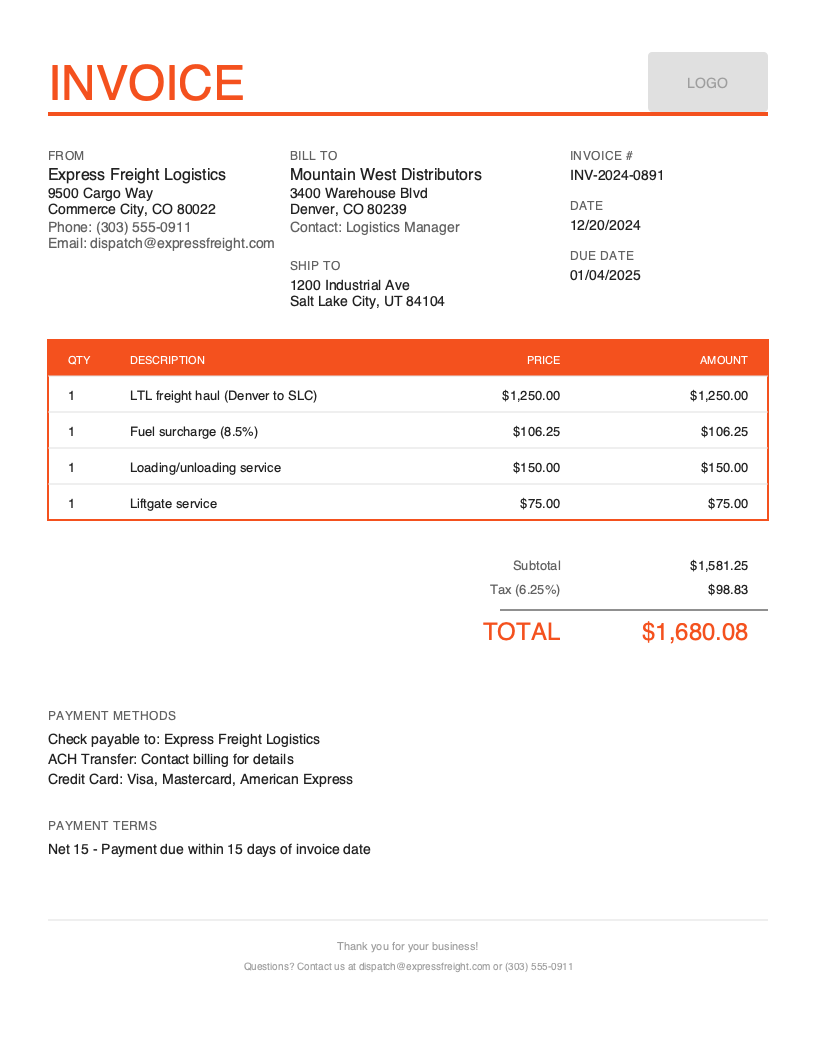
Download Free Transportation Invoice Template
Get Your Free Transportation Invoice Template
Download in your preferred format. Customize with your logo, colors, and business details. Start invoicing professionally in minutes.
Microsoft Word
Easy to customize, add your logo
Microsoft Excel
Auto-calculate totals and taxes
Transportation Invoice Template Variations
Choose from multiple professional designs. Customize colors, add your logo, and make it yours.
Default
Clean default layout
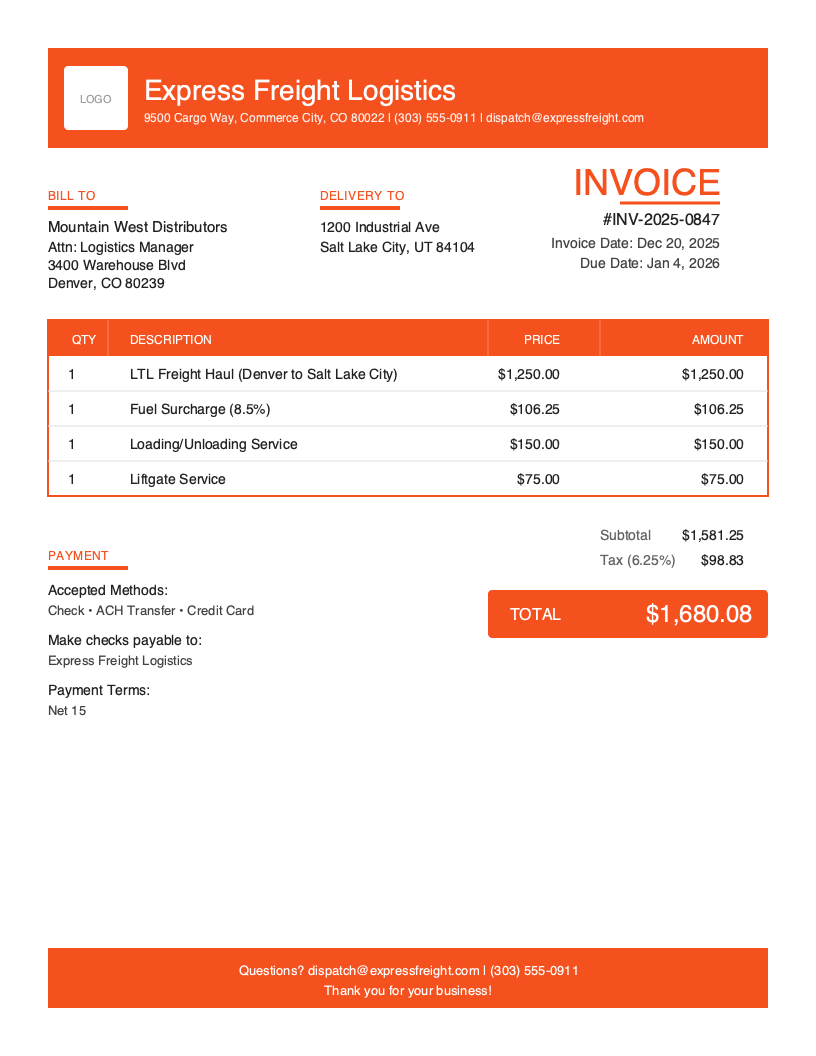
Bold
Branded, high-contrast header
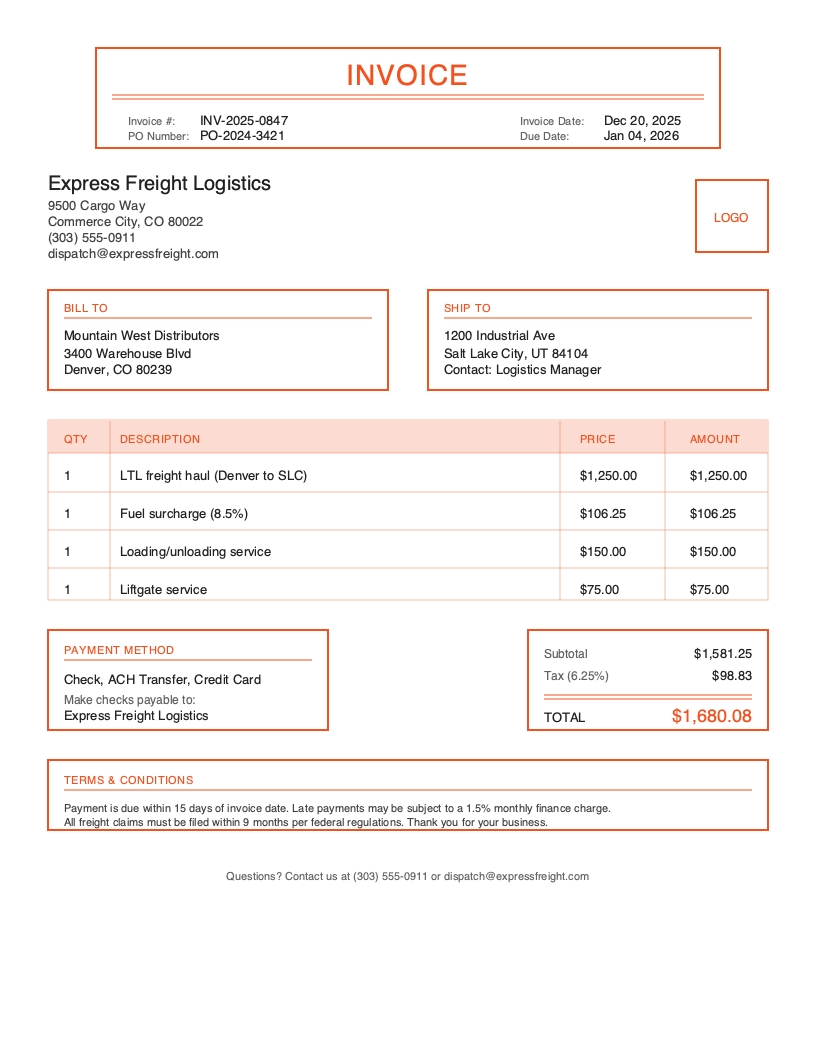
Classic
Traditional professional layout
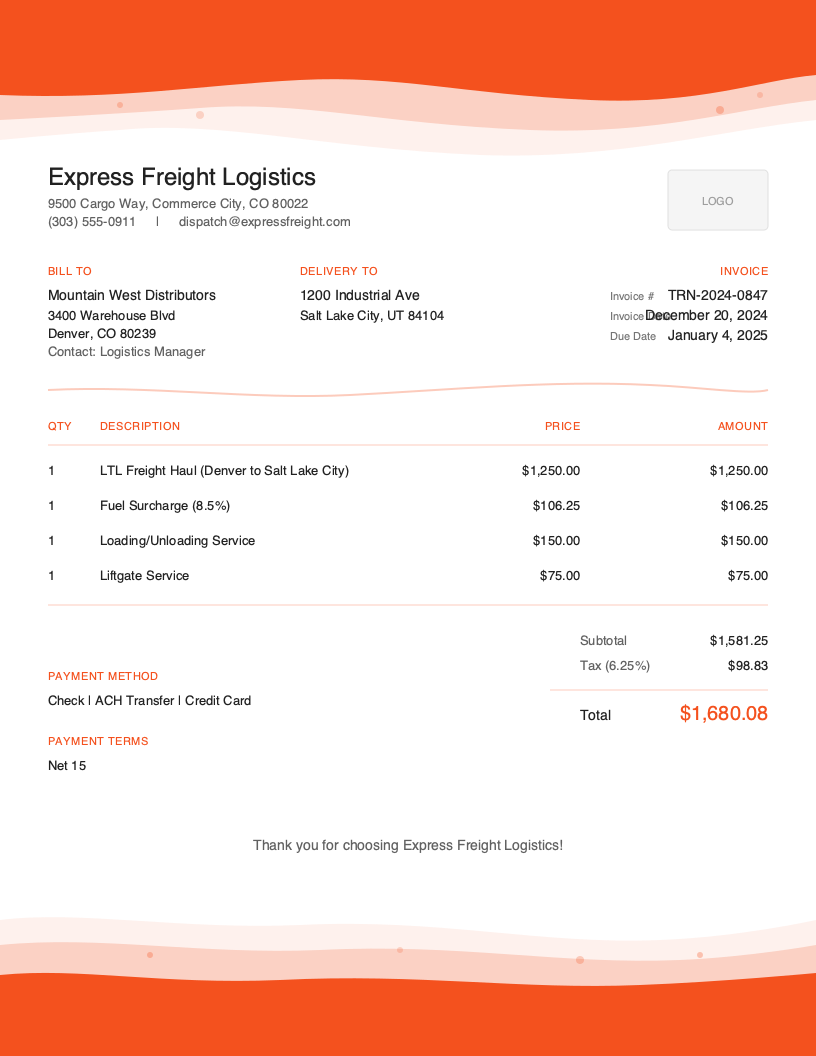
Artistic
Eye-catching color accent

Minimal
Clean, utility-first design
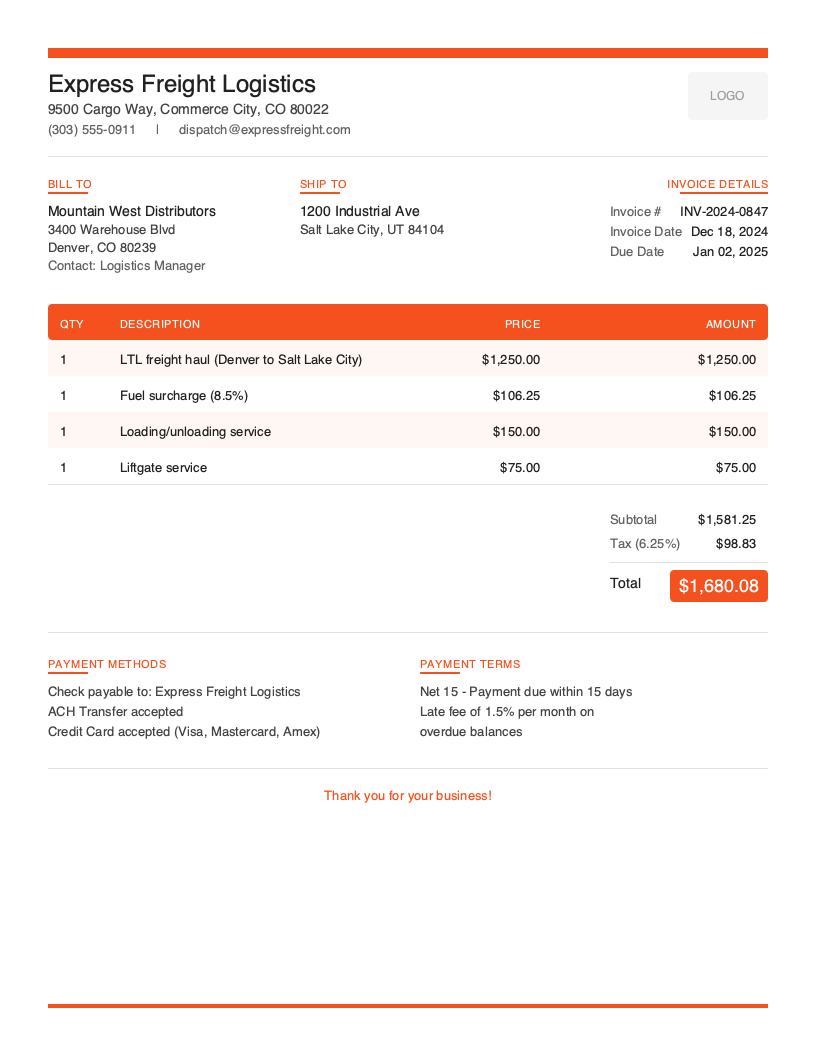
Modern
Clean, contemporary look
No signup required. Create and download instantly.
When you’ve just delivered a load after a 600-mile haul, the last thing you want is to lose hours chasing paperwork before you can bill the broker. Yet in transportation, getting paid depends entirely on sending a clean, complete invoice that ties back to the right load reference—ideally the same day you deliver.
Freight and delivery work involves layered pricing: per-mile rates, fuel surcharges, detention, lumper fees, and accessorial charges that brokers scrutinize line by line. Trucking moves more than 72% of all US freight tonnage, yet the average freight invoice still takes 40+ days to collect when references are missing or paperwork is incomplete. A disorganized invoice means held payments, broker disputes, and cash flow that stalls right when your fuel card needs reloading.
That’s why we’ve created free transportation invoice templates and a complete guide to freight invoicing. Whether you’re an owner-operator running one truck, a courier service, a livery operator, or managing a fleet, this page will help you invoice like a pro and get paid faster.
What You’ll Find on This Page
- Free downloadable transportation invoice templates (PDF, Word, Excel)
- Essential fields every freight and delivery invoice needs
- How to bill mileage, fuel surcharges, and accessorial charges correctly
- Industry-specific invoicing best practices for carriers and couriers
- How to create professional invoices in under 60 seconds from your phone
Download Free Transportation Invoice Templates
Get started immediately with our professionally designed transportation invoice templates. Choose your preferred format—the Excel template includes built-in formulas that automatically calculate line hauls (miles × rate per mile), fuel surcharge totals, accessorial charges, and grand totals so the math is always right before the invoice leaves your hands.
The Word template is ideal if you prefer to type details by hand or customize the layout for your carrier brand, while the Excel version is built for carriers who run multiple loads a week and want totals calculated automatically.
What to Include on Your Transportation Invoice
A professional transportation invoice must include specific information to clear broker and shipper accounting without delay. Unlike a generic invoice, a freight invoice needs load references, origin and destination details, mileage, and clearly separated fuel and accessorial charges so the bill payer can match it to their rate confirmation and release payment.
Required Invoice Sections
Carrier Business Information - List your legal business name, address, phone, email, and your MC and DOT numbers. Brokers verify these against their carrier packet, and including them upfront prevents your invoice from being set aside for verification.
Customer / Broker Information - Identify who is paying: the broker, shipper, or direct customer, with their billing address and accounts payable contact. Send the invoice to the correct AP inbox, not the dispatcher who booked the load.
Invoice Number and Dates - Assign a unique, sequential invoice number, and include both the invoice date and the delivery date. Sequential numbering keeps your books clean and makes follow-up calls simple.
Payment Terms - State the terms clearly (Net 30, Quick Pay, or factoring instructions) along with how to pay and where to remit. Ambiguity here is one of the most common reasons freight invoices age past 30 days.
Critical Transportation Invoice Elements
Load / BOL / PRO Reference Number - This is the single most important field on a freight invoice. Include the bill of lading number, load number, or PRO number exactly as it appears on the rate confirmation. Brokers match payments to references, and a missing or mismatched number stops your payment cold.
Origin and Destination - List the pickup city/state and the delivery city/state, with stop-off locations if the load was multi-stop. This lets the bill payer confirm the lane against the agreed rate at a glance.
Mileage and Rate - Show total miles and your billing method clearly. For per-mile loads, list rate per mile × total miles. For flat-rate or per-load freight, show the agreed line haul. For per-trip courier and livery work, show the trip or route rate. Make the calculation easy to verify.
Fuel Surcharge - List fuel surcharge as its own line, tied to the agreed fuel index or a per-mile surcharge amount. Keeping it separate from the line haul protects your rate when diesel prices shift and makes the charge transparent to the broker.
Accessorial Charges - Itemize every accessorial separately: detention/waiting time (with arrival and departure times), layover, lumper fees, stop-off charges, tarping, driver assist, and any reweigh or redelivery fees. Each accessorial should reference supporting documentation so nothing gets disputed away.
Understanding Transportation Business Invoicing
The US trucking industry generates over $940 billion in annual revenue and moves more than 72% of the nation’s freight by tonnage, supported by roughly 3.5 million professional drivers. Beyond long-haul trucking, the same invoicing fundamentals power freight brokerage, last-mile delivery, courier services, and rideshare and livery operators—each billing by mile, load, trip, or hour.
Cash flow is the defining challenge across the sector. With the average cost to operate a truck hovering around $1.60 per mile, accurate per-mile billing isn’t optional—small errors compound fast across thousands of miles. And because the average freight invoice can take 40+ days to collect, the difference between a complete invoice and an incomplete one is often the difference between making your next fuel and insurance payment on time.
Per-Mile and Per-Load Carriers
Owner-operators and fleets typically bill freight one of two ways. Per-mile billing multiplies a negotiated rate by practical or shortest-route miles—ideal for irregular lanes where mileage varies. Per-load (flat-rate) billing uses a single agreed line haul regardless of exact miles—common for dedicated lanes and brokered spot freight. Either way, your invoice should make the calculation obvious and tie it to the rate confirmation the broker already has on file.
Courier and Delivery Services
Local couriers and last-mile delivery operators often bill per stop, per route, or per package, sometimes with zone-based pricing and time windows. Adding waiting time, after-hours, and oversized-item charges as separate line items keeps your pricing transparent and your margins protected. For high-volume accounts, consolidating multiple deliveries onto a single weekly or monthly invoice with a clear stop log speeds approval.
Rideshare and Livery Operators
Livery, black car, and rideshare-style operators bill by trip, hour, or contracted rate, frequently for corporate accounts and event work. Itemizing the base fare, wait time, tolls, gratuity, and any cleaning or cancellation fees on a professional invoice helps you win and keep business accounts that expect documentation their own accounting can process.
Transportation Invoicing Best Practices
Invoice the Same Day You Deliver
The fastest way to get paid in freight is to bill the moment the load is delivered and the BOL is signed. Waiting days to invoice pushes your payment date further out and makes details harder to recall. Sending the invoice with the signed POD attached the same day starts the broker’s payment clock immediately.
Always Tie the Invoice to a Load Reference
Every transportation invoice should carry the BOL, load, or PRO number exactly as the customer uses it. This single field is what lets accounts payable match your bill to their open rate confirmation. Without it, your invoice sits in a queue waiting for someone to track down the load—and that someone is rarely in a hurry.
Itemize Fuel Surcharges and Accessorials Separately
Brokers and shippers expect to see the line haul, fuel surcharge, and each accessorial broken out. Bundling them into one number invites questions and short-pays. Separate line items for detention, layover, lumper, and stop-off charges—each backed by times and signatures—protect the revenue most carriers lose to undocumented work.
Attach Proof of Delivery and Supporting Documents
Most brokers will not release payment without a signed BOL or POD, and many require lumper receipts and scale tickets too. Attach these to the invoice from the start. Capturing photos of the signed paperwork on delivery and sending them with the invoice eliminates the back-and-forth that ages an invoice past its terms.
Offer Fast-Pay and Multiple Payment Options
Freight runs on cash flow. Make it easy to get paid by accepting ACH, card, and digital payments, and consider Quick Pay or factoring for loads you can’t wait 30 days on. Getting paid in days instead of weeks is often worth a small discount or fee when it keeps your trucks fueled and rolling.
Create Transportation Invoices in Under 60 Seconds
Stop losing billable hours to paperwork. Pronto Invoice’s mobile-first app is built for transportation professionals—carriers, couriers, and livery operators—who need to invoice the moment a load is delivered, right from the cab.
Creating a professional freight invoice takes five quick steps:
- Select your customer or broker from your saved contacts, or add a new one in seconds.
- Enter the load reference—BOL, load, or PRO number—plus origin and destination.
- Add your line haul—per-mile rate × miles, or a flat per-load or per-trip rate.
- Itemize fuel surcharge and accessorials like detention, layover, and lumper fees.
- Attach the signed POD and send—the invoice goes out with a built-in “Pay Now” button.
Features Transportation Professionals Need
Works Offline - Create and save invoices from loading docks, rural lanes, and dead zones with no signal. Your data syncs automatically once you’re back online.
Transportation-Specific Fields - Load and BOL reference tracking, origin-to-destination logging, per-mile and per-load rate options, separate fuel surcharge and accessorial line items, and photo attachments for signed BOLs and PODs.
Get Paid Faster - Accept card, ACH, and digital payments directly from your invoice, with clear payment terms and a “Pay Now” button so brokers and customers can settle without delay.
Whether you’re hauling freight cross-country, running last-mile deliveries, or managing a livery fleet, Pronto Invoice turns delivery paperwork into a 60-second task—so you spend less time billing and more time driving.
Transportation Invoicing Best Practices
Reference Every Load
Always include the BOL, load, or PRO number on your invoice. Brokers and shippers match payments to references, and missing numbers are the top cause of payment delays.
Bill Mileage Accurately
Use practical or shortest-route mileage your customer agreed to. Show origin, destination, and total miles so your per-mile rate is easy to verify and approve.
Itemize Fuel Surcharges
List fuel surcharge as a separate line tied to the current index. Transparent surcharges protect your margin and prevent rate disputes when diesel prices move.
Document Accessorials
Capture detention, layover, lumper, and stop-off charges with times and signatures. Undocumented accessorials are the revenue most carriers leave on the table.
Attach Proof of Delivery
Include signed BOL or POD with every invoice. Most brokers won't release payment without it, and attaching it upfront eliminates back-and-forth that delays your cash.
Frequently Asked Questions
A professional transportation invoice should include your carrier business information (MC and DOT numbers), the customer or broker name, the load or BOL reference number, origin and destination, equipment type, total miles, your rate (per mile, per load, or flat), itemized fuel surcharge and accessorial charges, payment terms, and a signed proof of delivery.
Bill detention as a separate line item once free time is exceeded, typically at an hourly rate after the first two hours at a stop. Record arrival and departure times and get a signature on the BOL. Other accessorials like layover, lumper fees, stop-offs, and tarping should each appear as their own documented line item.
Most broker and shipper freight invoices are Net 30, though Net 15 and Net 45 are also common. Many carriers use factoring to get paid within 24 hours for a small fee. For direct shipper accounts, you can negotiate Quick Pay options that pay in 2 to 7 days at a small discount.
Related Invoice Templates
Start Creating Professional Transportation Invoices Today
Join thousands of professionals who use Pronto Invoice to get paid faster. Create your first invoice in under 60 seconds.
This guide is for informational purposes only and does not constitute legal or tax advice.