
Free Rent Receipt Template
Create professional rent receipts in under 30 seconds. Download free templates with rental period, property address, tenant name, PAID stamp, and tracking.
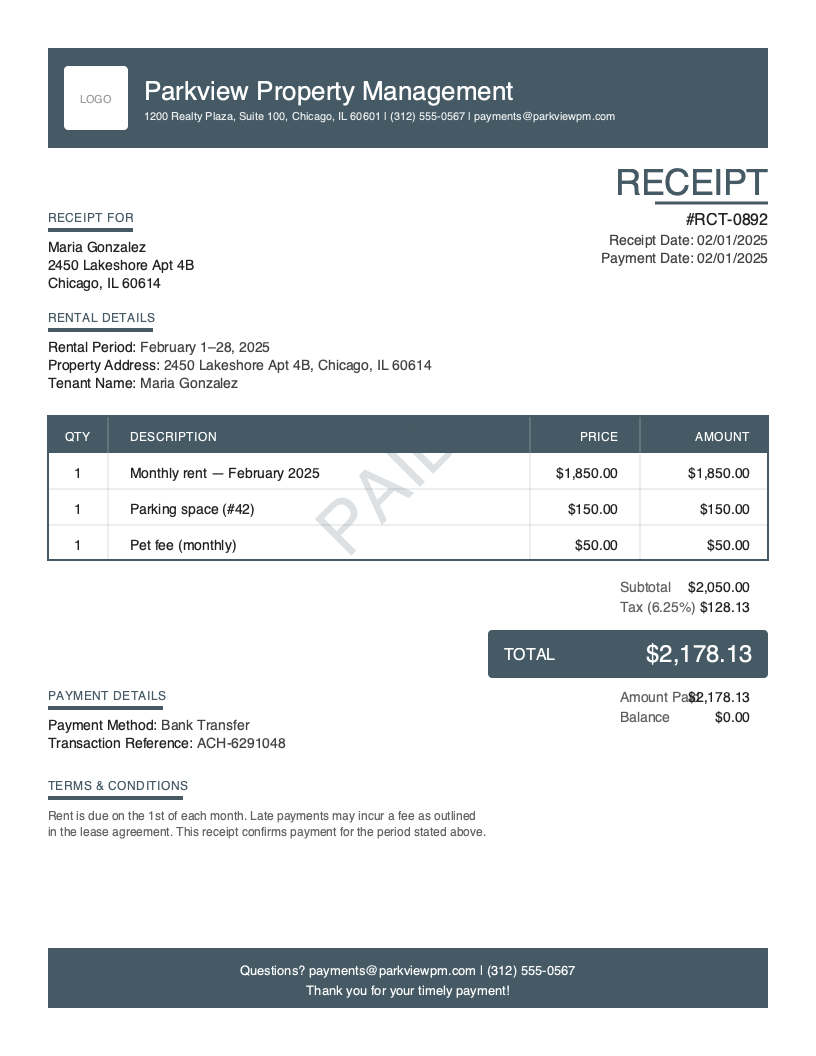
Download Free Rent Receipt Template
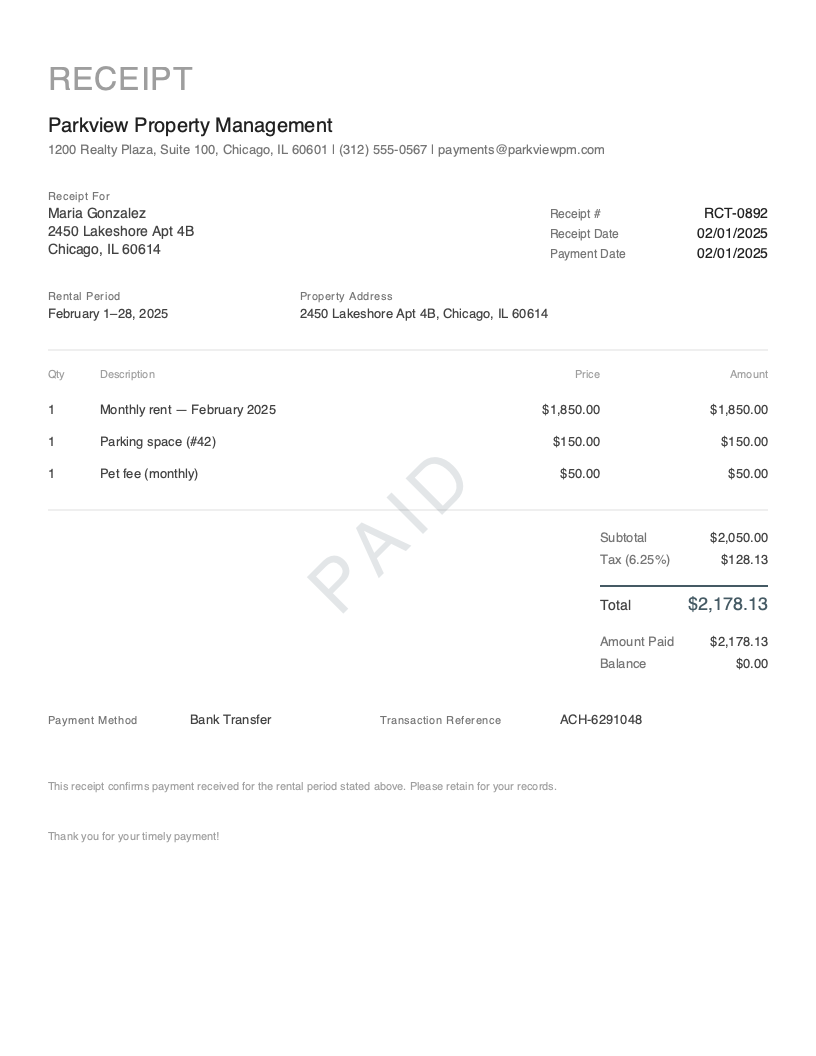
Get Your Free Rent Receipt Template
Download in your preferred format. Customize with your logo, colors, and business details. Start issuing professional receipts in minutes.
Microsoft Word
Easy to customize, add your logo
Microsoft Excel
Auto-calculate totals and taxes
At least 16 U.S. states require landlords to provide written rent receipts under certain conditions
Time to create and deliver a professional rent receipt with property address, rental period, and PAID stamp
Minimum recommended time to keep rent receipt copies for tax audits, disputes, and legal proceedings
First of the month. Your tenant transfers $1,850 for February rent, plus $150 for parking space #42 and $50 for the monthly pet fee. The bank transfer clears, you note the ACH reference number, and now you need to hand them a receipt. Not next week — today. In several states, you’re legally required to provide one. In all states, it’s the professional thing to do.
Rent receipts are among the most legally significant receipt types in the United States. At least 16 states — including California, Massachusetts, New York, Maryland, and Washington — require landlords to provide written receipts for rent payments, and several impose penalties for failure to comply. Even in states without a mandate, rent receipts protect both landlord and tenant: the landlord has proof of collection, the tenant has proof of payment for tax deductions, housing applications, and dispute resolution.
Here’s the distinction that matters: a rent receipt confirms that rent was received for a specific period at a specific property. It is not a lease agreement, not a rent invoice, and not a late notice. It’s the document your tenant files with their tax return, shows to their next landlord as proof of payment history, or presents in court if a payment dispute arises. Every rent receipt should include a PAID stamp, the rental period, the property address, the tenant’s name, and the payment method used.
What you’ll find on this page:
- Free downloadable rent receipt templates (Word & Excel)
- Complete breakdown of required rent receipt elements
- When and why landlords must provide rent receipts
- State-by-state legal requirements overview
- Best practices for professional rent documentation
Download Free Rent Receipt Templates
Get started immediately with our professionally designed rent receipt templates. Both formats include a PAID stamp, rental period field, property address, tenant name, and payment tracking.
| Format | Best For | Download |
|---|---|---|
| Microsoft Word | Easy customization — add your property management company name, logo, and property details | Download Word |
| Microsoft Excel | Auto-calculate monthly rent, additional charges (parking, pet fees, utilities), and totals | Download Excel |
Tip: The Excel template includes built-in formulas that total monthly rent plus additional charges like parking, storage, pet fees, and utilities. Enter each line item — the receipt calculates the total automatically.
Both templates include a PAID stamp, rental period dates, property address, tenant name, and payment method — the elements required by state landlord-tenant laws and expected by tenants.
Want more polished designs? Create custom receipts with our receipt generator.
What to Include on a Rent Receipt
A rent receipt documents a single fact: rent was paid for a specific property during a specific period. Unlike a lease (which defines the rental terms) or a rent invoice (which requests payment), a rent receipt confirms that money changed hands. The tenant needs this document for tax filings, housing applications, and payment dispute protection. The landlord needs it for income documentation and legal compliance.
Required Receipt Sections
| Section | What to Include | Why It Matters for Rent |
|---|---|---|
| Receipt Header | Receipt number (RCT-0001), receipt date, document title “RECEIPT” | Creates a traceable monthly record — essential for annual tax documentation |
| Business Information | Landlord or property management company name, address, phone, email | Identifies the party collecting rent; required on receipts in most regulated states |
| Client Information | Tenant name and mailing address | Links the receipt to the specific tenant on the lease |
| Rental Information | Rental period, property address, tenant name | Rent-specific — the defining section; ties the payment to a specific unit for a specific month |
| Line Items | Monthly rent, parking, pet fees, utilities, storage, or other charges | Itemizes what the payment covers beyond base rent |
| Pricing Summary | Subtotal, tax (if applicable), total, amount paid, balance ($0.00) | Confirms the full monthly amount was received |
| Payment Details | Payment method (bank transfer, check, cash, etc.), transaction reference, payment date | Documents how rent was paid — critical for cash payments where no digital trail exists |
| PAID Indicator | Prominent PAID stamp or badge | Immediately communicates the payment is settled — the tenant’s primary proof |
| Terms & Conditions | Late fee policy reference, lease agreement reference | Brief reference to governing terms; the lease itself contains the full agreement |
| Thank You Message | Brief acknowledgment | Professional close; reinforces positive landlord-tenant relationship |
Critical Rent Receipt Elements
Rental Period Every rent receipt must specify exactly which period the payment covers: “February 1–28, 2026” or “March 1–31, 2026.” Without this, a receipt is ambiguous — does it cover last month, this month, or a security deposit? For tenants claiming rent deductions on their taxes, the IRS expects documentation tied to specific months. For landlords in eviction proceedings, receipts with clear rental periods establish which months were paid and which were not.
Property Address and Unit Number The receipt must identify the specific rental unit: “2450 Lakeshore Drive, Apt 4B, Chicago, IL 60614.” Landlords managing multiple properties need receipts tied to individual units for accurate income tracking. Tenants applying for new housing present rent receipts as payment history — the property address verifies where they lived and what they paid. For multi-unit buildings, always include the apartment or unit number.
Tenant Name The receipt should name the tenant on the lease, not just “Occupant” or “Resident.” If multiple tenants are on the lease, name the person who made the payment. This matters for individual tax filings (only the paying tenant can claim the deduction in states that offer one) and for housing applications where landlords verify specific individuals’ payment history.
Payment Method and Reference Document whether rent was paid by bank transfer (include ACH reference), check (include check number), money order (include serial number), cash (note “Cash — no reference”), or digital payment (include Zelle/Venmo confirmation). Cash payments are the highest-risk category for disputes — a rent receipt with “Payment Method: Cash” and a PAID stamp is often the only proof that payment occurred. This is precisely why many state laws requiring rent receipts were created: to protect tenants who pay in cash.
Understanding Rent Receipts
When You Need a Rent Receipt
Rent receipts are needed in several recurring scenarios:
Monthly rent collection. The most common use — every month, the tenant pays rent, and the landlord provides a receipt. In states that mandate receipts, this is a legal obligation with every payment. Even in non-mandated states, consistent monthly receipts create a clean payment history for both parties.
Cash rent payments. When tenants pay in cash, there is zero digital trail. No bank statement, no cancelled check, no Venmo confirmation. The rent receipt is the only documentation that the payment occurred. This is the scenario that drives most state receipt mandates — protecting vulnerable tenants who pay cash from landlords who might claim non-payment.
Tenant tax deductions. Several states offer rent deductions or credits on state income taxes — including Massachusetts, Indiana, Michigan, and others. Tenants need receipts to substantiate these deductions. Without receipts, they lose the tax benefit.
Housing applications. When tenants apply for a new apartment, landlords commonly request proof of consistent rent payment. A stack of monthly rent receipts with PAID stamps is the gold standard. Bank statements work, but dedicated rent receipts are cleaner and more credible.
Dispute resolution. If a landlord claims non-payment and initiates eviction proceedings, the tenant’s rent receipts are primary evidence. In court, a signed or stamped rent receipt is stronger than a verbal claim that payment was made. This is why states mandate receipts — they create a paper trail that protects both parties.
Who Uses Rent Receipts
Rent receipts serve a content-only audience for Pronto Invoice — primarily landlords, property managers, and tenants. Independent landlords managing one to ten units are the largest segment. They often lack property management software and rely on templates, spreadsheets, or handwritten receipts. Property management companies with professional systems generate receipts automatically, but smaller operations need standalone tools.
Tenants sometimes create their own receipt records when landlords fail to provide them — though the legal obligation falls on the landlord in mandated states.
Rent Receipts vs. Invoices
A rent invoice says: “Your February rent of $2,050 is due by February 1.” A rent receipt says: “We received $2,050 for February rent on February 1. PAID.” Some landlords send invoices before the due date as reminders, then issue receipts after payment clears. Others skip invoices entirely and only issue receipts — particularly for long-term tenants on auto-pay. The receipt is the legally significant document; the invoice is optional.
State Legal Requirements
Rent receipt laws vary significantly by state. Here’s an overview of key states:
States requiring rent receipts (partial list):
- California — landlords must provide receipts for cash payments; tenants can request receipts for any payment method
- Massachusetts — landlords must provide receipts for all rent payments within 30 days
- New York — landlords must provide receipts for cash payments; tenants in rent-stabilized or rent-controlled apartments can request receipts for any payment
- Maryland — landlords must provide receipts upon tenant request
- Washington — landlords must provide receipts for cash payments
- New Jersey — landlords must provide receipts for all rent payments
Penalties for non-compliance vary: some states allow tenants to withhold rent, others impose fines, and some allow tenants to use non-receipt as evidence in eviction defense. Always check your state’s current landlord-tenant laws — requirements change, and local ordinances may add additional obligations.
Creating Rent Receipts Efficiently
Downloadable templates work well for landlords managing a handful of units. Fill in the tenant name, property address, rental period, payment amount, and method — print or email the receipt. For landlords who want to save time, our Word and Excel templates at the top of this page are ready to use immediately.
For landlords who also run a business and need invoicing, estimates, and payment tracking beyond rent, Pronto Invoice handles recurring billing, receipt generation, and client management for small businesses. While rent-specific features aren’t part of our core product, landlords who also invoice for services — property maintenance, consulting, contracting — use Pronto Invoice for the business side of their operations.
Try Pronto Invoice for business invoicing →
Related Receipt Templates
Looking for other receipt types? Browse our complete collection:
- Cash Receipt Template — cash payment documentation with signature field
- Deposit Receipt Template — partial payments and security deposits
- Payment Receipt Template — general payment confirmations
- Sales Receipt Template — product and service purchase receipts
- All Receipt Templates
- All Invoice Templates
Start Providing Professional Rent Receipts Today
Your tenants deserve clear, professional documentation of every rent payment — and in many states, it’s the law. Download our free rent receipt templates above to start issuing polished receipts with PAID stamps, rental period tracking, and itemized charges immediately.
Download Free Rent Receipt Template → | Browse All Receipt Templates →
This guide is for informational purposes only and does not constitute legal or tax advice. Consult with a qualified professional for guidance specific to your situation and jurisdiction.
Last updated: March 2026
Rent Receipt Best Practices
Issue Receipts for Every Payment — Not Just When Required
Even if your state doesn't mandate rent receipts, issue them consistently. Monthly receipts create an unambiguous payment history that protects you in disputes, simplifies tax reporting, and demonstrates professionalism.
Include the Complete Property Address and Rental Period
Specify the full property address with unit number and the exact rental period: '2450 Lakeshore Drive, Apt 4B — February 1–28, 2026.' This specificity matters for tax documentation, housing applications, and legal proceedings.
Use Professional, Branded Templates
Your rent receipt represents your property management standards. A clean, organized receipt with your company name, property address, and clear payment details signals a professional operation.
Document Cash Payments with Extra Care
Cash rent payments are the highest-risk transactions for both landlord and tenant. Issue the receipt immediately — before the tenant leaves. Include 'Payment Method: Cash' prominently and consider having the tenant sign acknowledging the amount.
Maintain a Consistent Numbering System
Number every rent receipt sequentially. For multiple properties, consider a property-based prefix: 'LAKE-0001' for Lakeshore, 'OAK-0001' for Oakwood. Sequential numbering identifies gaps and simplifies year-end tax preparation.
Archive Receipts for at Least Three Years
The IRS recommends keeping financial records for at least three years. Store digital copies organized by property and year. When a former tenant needs a receipt copy for a mortgage application, you'll have it.
Include Additional Charges as Separate Line Items
Itemize each charge separately: 'Monthly Rent: $1,850, Parking Space #42: $150, Pet Fee: $50.' This transparency prevents disputes and helps tenants who need to separate rent from other charges for tax purposes.
Frequently Asked Questions
A professional rent receipt should include: the landlord or property management company name and contact information; the tenant's name; the property address with unit number; the rental period covered (e.g., 'February 1–28, 2026'); itemized charges (base rent, parking, pet fees, etc.); the total amount paid; the payment method and transaction reference; the payment date; and a PAID stamp or indicator confirming the payment was received.
No. A rent invoice is sent before the due date requesting payment — 'Your February rent of $2,050 is due by February 1.' A rent receipt is issued after payment confirming money was received — 'We received $2,050 for February rent on February 1. PAID.' The invoice creates the obligation; the receipt proves it was met. Many landlords skip invoices for long-term tenants and only issue receipts.
It depends on your state. At least 16 states require landlords to provide rent receipts under certain conditions — most commonly for cash payments. California, Massachusetts, New York, Maryland, Washington, and New Jersey are among the states with receipt requirements. Even in states without a mandate, providing receipts is strongly recommended.
Yes, in states that offer rent deductions or credits. Massachusetts, Indiana, Michigan, Wisconsin, and several other states allow tenants to deduct a portion of rent paid on their state income tax returns. Tenants need receipts to substantiate these deductions.
Download our free Word or Excel template at the top of this page and fill it in on your phone or tablet. Include the property address, rental period, tenant name, amount, payment method, and a PAID indicator every time.
In states that only mandate receipts for cash payments, bank transfers create their own digital trail, so a receipt may not be legally required. However, providing receipts for all payment methods is best practice — the tenant's bank statement doesn't specify the rental period, property address, or that the payment was specifically for rent.
Keep copies of all rent receipts for at least three years — the IRS standard retention period. Many landlords keep them for five to seven years as additional protection. Store digital copies organized by property address and year.
Related Receipt Templates
Start Creating Professional Receipts Today
Create your first receipt in under 30 seconds. Join thousands of professionals who use Pronto Invoice to issue receipts on the spot.
This guide is for informational purposes only and does not constitute legal or tax advice.